
Articles

Catalyzing Systemic Transformation, A Theory of Change for TVET in Bangladesh

Bangladesh is currently navigating a profound demographic transition, presenting an unprecedented opportunity to leverage its youth bulge for accelerated economic growth. However, realizing this potential requires a structural departure from traditional educational paradigms toward a highly responsive, industry-aligned Technical and Vocational Education and Training (TVET) ecosystem. This article provides a comprehensive exploration of the Theory of Change (ToC) necessary to drive systemic reform within the Bangladeshi TVET sector. By mapping the causal pathways from initial resource inputs to ultimate socio-economic impact, the framework addresses critical components such as Competency-Based Training and Assessment (CBT&A), the integration of Green TVET, localized crisis responses in regions like Cox’s Bazar, and the imperative of robust career counseling. Ultimately, this article argues that sustainable workforce development relies not merely on the proliferation of training centers, but on a holistic, evidence-based strategy that inextricably links technical competency with long-term economic resilience.

Introduction, The Critical Juncture of Skills Development in Bangladesh

As Bangladesh approaches its graduation from the Least Developed Country (LDC) category in 2026 and sets its sights on achieving developed nation status by 2041, the nation’s economic architecture is undergoing a massive transformation. Central to this transition is the optimization of human capital. Every year, more than two million young people enter the Bangladeshi labor market. While general education has historically been the default pathway, the escalating demand for specialized, technical skills has exposed the limitations of traditional academic degrees. A profound skills mismatch currently exists, where industries struggle to find competent workers while university graduates face alarming rates of underemployment.

To address this disparity, the Government of Bangladesh, guided by the Technical and Madrasah Education Division (TMED) and various national stakeholders, has prioritized the expansion and modernization of the TVET sector. However, building infrastructure and increasing enrollment numbers are only the initial steps. True sectoral reform requires a rigorous methodology to ensure that the training delivered translates directly into decent work, poverty reduction, and national productivity. This is where the Theory of Change becomes indispensable. It provides the strategic roadmap, detailing exactly how specific educational interventions will trigger the systemic transformations required to build a globally competitive workforce.

Deconstructing the Theory of Change in the TVET Sector

A Theory of Change is not merely an administrative document or a basic logical framework. It is a comprehensive illustration of the causal linkages that explain how and why a desired change is expected to occur in a specific context. In the realm of TVET, the ToC forces policymakers, curriculum developers, and master trainers to shift their focus from tracking basic activities, such as the number of classes held, to measuring actual, life-altering outcomes.

The logic model operates sequentially, ensuring that every resource utilized has a direct line of sight to the ultimate economic goal. If a project aims to elevate the livelihood of youth in a rural upazila, the ToC maps the journey backward from that goal to the present day, identifying the necessary conditions for success.

The fundamental pillars of the TVET Theory of Change in Bangladesh can be categorized as follows:

Stage Definition Application in Bangladesh TVET
Inputs The foundational resources invested. Government funding, donor investments, occupational standards, master trainers, physical infrastructure in TTCs and polytechnic institutes.
Activities The operational actions executed. Conducting Training of Trainers (ToT), developing Competency-Based Learning Materials (CBLM), establishing Industry Skills Councils (ISCs).
Outputs The immediate, tangible deliverables. Number of youths securing BTEB certification, number of active centers of excellence, published session plans and assessment tools.
Outcomes The medium-term changes in status. Graduates securing formal employment, youths launching entrepreneurial ventures, industries adopting standardized competency metrics.
Impact The long-term systemic change. Sustained poverty reduction, transition to a climate-adaptive green economy, realization of Vision 2041 economic targets.

Through this matrix, stakeholders can identify potential points of failure. For example, if a program generates a high volume of certified outputs but fails to achieve employment outcomes, the ToC highlights a breakdown in industry linkage or career counseling, prompting immediate strategic correction.

The Institutional Architecture and Policy Framework

For a Theory of Change to be effective, it must be embedded within a robust institutional framework. In Bangladesh, the governance of skills development has evolved significantly to accommodate the complexities of a modern economy. The National Skills Development Authority (NSDA), operating under the Prime Minister’s Office, serves as the apex body for policy coordination, standard-setting, and quality assurance across the nation.

Working in tandem with the NSDA is the Bangladesh Technical Education Board (BTEB), which retains the critical mandate for curriculum development, assessment regulation, and the certification of both learners and instructors. The cornerstone of this regulatory environment is the National Technical and Vocational Qualifications Framework (NTVQF). The NTVQF categorizes skills into distinct levels, ranging from basic pre-vocational capabilities up to advanced diploma levels, ensuring that qualifications are standardized, transparent, and nationally recognized.

Furthermore, the Theory of Change relies heavily on the active participation of the private sector, facilitated through Industry Skills Councils (ISCs). These councils ensure that the competency standards developed by the BTEB are not created in an academic vacuum but are directly derived from real-time market demands. By integrating industry leaders into the curriculum design phase, the TVET sector ensures that its ultimate outputs, the skilled graduates, are precisely what the employers require. Additionally, the system embraces the informal economy through the Recognition of Prior Learning (RPL) mechanism, allowing experienced but uncertified workers to gain formal NTVQF credentials, thereby formalizing their expertise and enhancing their earning potential.

 Competency-Based Training and Assessment (CBT&A), The Pedagogical Engine

The most profound paradigm shift within the Bangladeshi TVET sector has been the transition from time-bound, rote-learning models to Competency-Based Training and Assessment (CBT&A). In a traditional system, a student spends a fixed amount of time in a classroom and passes a written exam. In the CBT&A model, time is a variable and competency is the constant. The primary focus is on what the learner can actually do in a real-world workplace setting.

The ToC relies on CBT&A as its primary activity engine. The methodology mandates the development of rigorous Competency Standards (CS) for every specific occupation, breaking down complex trades into modular elements of competency. Instructors, acting as facilitators rather than traditional teachers, utilize Competency-Based Learning Materials (CBLM) to guide students through practical demonstrations of skill.

This model places immense responsibility on the shoulders of the educators. Consequently, developing a cadre of highly skilled Master Trainers and BTEB-certified Assessors is a critical input. These professionals must possess not only deep technical knowledge but also advanced pedagogical skills to manage varied learning paces and conduct evidence-based assessments. When an assessor signs off on a student’s competency, they are providing a guarantee to the industry that the individual can perform the specific occupational tasks safely and efficiently. This rigorous quality assurance is what ultimately drives employer trust and secures the desired employment outcomes.

Green TVET and Climate-Adaptive Skills

Bangladesh stands uniquely vulnerable to the impacts of global climate change. As the nation industrializes, it faces the dual challenge of expanding its manufacturing capacity while minimizing environmental degradation. Therefore, a modern Theory of Change for TVET cannot merely focus on traditional trades, it must proactively integrate environmental sustainability. This imperative has given rise to the concept of Green TVET.

Green TVET involves a systemic overhaul of the curriculum to foster a carbon-conscious workforce. It operates on two distinct fronts. First, it involves the creation of entirely new occupational standards for emerging green sectors. As international initiatives and projects spearhead the transition to renewable energy, there is an urgent need for technicians skilled in solar panel installation, wind turbine maintenance, and biogas plant operations.

Second, Green TVET requires the integration of sustainable practices into existing, traditional trades. A conventionally trained mason must learn sustainable construction techniques and material optimization. A garments worker must understand waste reduction, chemical management, and energy efficiency on the factory floor. By training instructors on climate-adaptive pedagogies, the TVET system ensures that the next generation of technicians will enter the workforce equipped to drive the nation’s transition to a green economy, fulfilling a critical long-term impact metric.

Localizing Interventions, A Focus on Cox’s Bazar and Fragile Economies

While national frameworks provide the structural foundation, a successful Theory of Change must be highly adaptable to localized socio-economic realities. Interventions that succeed in the industrial hubs of Dhaka or Gazipur may fail in rural or crisis-affected districts. A prime example of this necessity is the implementation of skills programs in Cox’s Bazar zila.

The geopolitical landscape of Cox’s Bazar has been dramatically altered by the massive influx of displaced populations, placing immense strain on the local economy, infrastructure, and the livelihoods of the host communities. In such fragile environments, a generic approach to vocational training is insufficient. Projects aimed at improving skills and employment in these specific upazilas require a deeply contextualized ToC.

Interventions here must prioritize rapid, market-driven skills delivery that can generate immediate income and alleviate social tension. The focus often shifts toward agriculture-tech, localized supply chain logistics, specialized hospitality services, and light engineering trades that serve the immediate logistical needs of the region. By conducting hyper-local labor market assessments and partnering with regional enterprises, TVET initiatives can bypass broader national bottlenecks and create direct pipelines from training centers to local employment, fostering economic resilience and social cohesion in highly volatile areas.

Bridging the Gap, Career Counseling and Behavioral Assessment

A critical vulnerability in many historical TVET projects has been the assumption that producing a certified graduate automatically results in employment. This gap between the output (certification) and the outcome (job placement) is where many well-intentioned programs falter. To solidify this crucial link in the ToC, institutions must integrate comprehensive career counseling and behavioral support systems directly into the training lifecycle.

The modern job market demands more than just technical proficiency, it requires distinct behavioral competencies, emotional resilience, and professional adaptability. Innovative approaches, such as establishing dedicated career centers and utilizing advanced placement frameworks, are essential. By integrating psychometric testing and behavioral profiling, institutions can align a student’s natural aptitudes with the appropriate trade, drastically reducing dropout rates and future job dissatisfaction.

Furthermore, implementing structured employability scoring provides prospective employers with a holistic view of a candidate, encompassing both their BTEB-certified technical skills and their communication, teamwork, and problem-solving abilities. When career counseling is treated as a core curriculum component rather than an optional afterthought, the TVET system effectively transforms job seekers into highly desirable industry assets, cementing the ultimate outcomes of the Theory of Change.

Fostering Youth Entrepreneurship

The assumption that all TVET graduates will enter formal employment is fundamentally flawed, particularly in a developing economy with a vast informal sector and limited corporate absorption capacity. A robust Theory of Change must acknowledge and actively support self-employment and micro-enterprise development as primary outcome pathways.

Fostering entrepreneurship requires a deliberate pedagogical strategy. Technical mastery of a trade, such as refrigeration repair or specialized tailoring, does not inherently equip an individual with the business acumen required to run a profitable enterprise. Therefore, applied entrepreneurship modules must be woven into the core CBT&A curriculum.

These modules must go beyond basic theory, teaching students practical skills in localized market analysis, supply chain management, digital marketing, and financial literacy. Crucially, the TVET ecosystem must facilitate linkages with microfinance institutions and SME support networks, helping young tradespeople secure the initial capital required to purchase equipment and establish their businesses. By cultivating a mindset shift from seeking jobs to creating jobs, the TVET system can act as a profound catalyst for decentralized economic growth across rural upazilas and urban centers alike.

Digital Pedagogy and Systemic Resilience

The global disruptions of recent years have unequivocally demonstrated that traditional, strictly in-person models of education are highly vulnerable. For the TVET sector, which relies heavily on hands-on practical training, this presented a unique crisis. Consequently, the modernization of TVET delivery through digital pedagogy has become an essential activity within the broader Theory of Change, ensuring systemic resilience against future shocks.

The integration of technology extends far beyond simple video lectures. It involves the deployment of comprehensive Learning Management Systems (LMS) tailored for vocational education. Through blended learning models, the theoretical components of a competency standard can be delivered via interactive online modules, while physical workshop time is strictly reserved for practical demonstration and assessment.

Furthermore, establishing virtual academies and digital resource repositories empowers instructors across the country. A master trainer in a major city can simultaneously upgrade the pedagogical skills of instructors in remote upazilas through synchronized digital sessions. By embracing digital transformation, the TVET ecosystem not only enhances the quality and standardizes the delivery of education but also significantly expands its geographical reach, democratizing access to premium technical training.

Social Inclusion and Gender Parity

An effective Theory of Change must be inherently inclusive, ensuring that the economic benefits of skills development are equitably distributed across all strata of society. Historically, the TVET sector in Bangladesh has struggled with gender disparity, with female enrollment often concentrated in traditional, lower-paying trades such as tailoring or beautification.

Systemic reform requires targeted interventions to break down cultural barriers and encourage female participation in high-growth, non-traditional sectors like electronics, plumbing, automotive repair, and information technology. This involves a multi-faceted approach, including providing targeted stipends, ensuring safe transportation, establishing secure and inclusive physical infrastructure at training centers, and deploying gender-sensitized learning materials.

Beyond gender parity, the system must actively integrate persons with disabilities and marginalized youth from geographically isolated regions. By designing adaptable assessment tools, offering flexible training schedules, and promoting inclusive workplace policies among partner industries, the TVET sector ensures that no demographic is left behind. When a system successfully elevates its most vulnerable populations into skilled, productive roles, the resultant societal impact is profoundly transformative.

Monitoring, Evaluation, and Continuous Quality Improvement

The final, and perhaps most crucial, component of a successful Theory of Change is a rigorous framework for Monitoring, Evaluation, and Learning (MEL). A ToC is not a static document, it is a living hypothesis that must be constantly tested against real-world data.

The sector must move beyond simply auditing financial expenditures and counting enrollment figures. Robust tracer studies must be institutionalized to track graduates post-certification, analyzing their employment status, income trajectories, and career progression over time. Simultaneously, continuous feedback loops must be established with industry partners through employer satisfaction surveys, evaluating whether the certified competencies are actually meeting the evolving demands of the factory floor.

When discrepancies are identified, such as a high certification rate but low industry absorption in a specific trade, the data must instantly trigger a review of the curriculum, the assessment methodology, or the quality of the instructional delivery. This commitment to continuous quality improvement ensures that the TVET system remains agile, responsive, and consistently aligned with its ultimate economic objectives.

Conclusion: A Forward-Looking Ecosystem

The transformation of the TVET sector in Bangladesh is not merely an educational upgrade, it is an economic imperative. As the nation stands on the precipice of advanced economic status, the demand for a highly skilled, adaptable, and innovative workforce has never been more acute.

Implementing a robust Theory of Change ensures that the immense investments flowing into the sector are not squandered on fragmented activities but are strategically channeled toward measurable, life-changing outcomes. By embracing the rigor of CBT&A, championing Green TVET, addressing regional complexities, integrating behavioral counseling, and maintaining a relentless focus on industry alignment, the stakeholders of the Bangladeshi skills ecosystem can forge a sustainable path forward. The ultimate success of this endeavor will be reflected not in the number of certificates printed, but in the thriving enterprises, the localized economic stability, and the empowered, self-reliant youth driving the future of Bangladesh.

About the Author

Khan Mohammad Mahmud Hasan is a distinguished Technical and Vocational Education and Training (TVET) expert, curriculum specialist, and master trainer based in Bangladesh. With extensive experience orchestrating systemic reforms across the national skills ecosystem, he specializes in the implementation of Competency-Based Training and Assessment (CBT&A) methodologies, Green TVET, and advanced digital pedagogy. Serving in critical leadership roles, including Technical Consultant for prominent skills and employment initiatives in Cox’s Bazar and National Team Leader for high-impact renewable energy curriculum projects, he bridges the gap between national policy and localized execution.  Author’s Website
Sectoral Analysis: TVET for Renewable Energies in Bangladesh

As Bangladesh accelerates its trajectory toward sustained economic development, the dual imperatives of meeting surging energy demands and mitigating the escalating impacts of climate change have placed the nation at a critical crossroads. Central to navigating this challenge is a fundamental shift toward a renewable energy framework, moving away from carbon-intensive power generation to ensure long-term energy security and environmental sustainability. However, realizing this ambitious green energy transition requires more than just technological investment and policy reform; it fundamentally demands a robust, future-ready workforce.

Technical and Vocational Education and Training (TVET) stands as the crucial bridge between ambitious climate targets and on-the-ground implementation. By equipping workers with specialized “Green Skills,” TVET not only ensures the safe, innovative, and efficient deployment of renewable technologies but also guarantees that this economic shift provides decent work opportunities and leaves no vulnerable populations behind, embodying the core principles of a Just Transition. The following analysis explores the intersection of renewable energy expansion and vocational education in Bangladesh, highlighting the indispensable role of targeted TVET interventions in building the human capital necessary to power a sustainable, green economy.

The Global Shift and the Concept of a Just Transition

The global imperative to mitigate climate change and foster sustainable economic development has placed renewable energy at the forefront of international policy. For developing nations like Bangladesh, this transition is not just about reducing carbon emissions; it is fundamentally about ensuring energy security, driving economic growth, and eradicating poverty. Climate change, biodiversity loss, and rising social inequality pose existential threats to global stability. To combat these challenges, the world must transition to a Green Economy—an economic model that significantly reduces environmental risks and resource scarcity while improving human well-being and social equity. In the context of the energy sector, this means phasing out carbon-intensive power generation and accelerating the deployment of renewable energy sources.

The concept of a “Just Transition” is central to this shift. The International Labour Organization (ILO) defines a Just Transition as greening the economy in a way that is fair and inclusive, creating decent work opportunities, and ensuring that no one is left behind. While the shift away from fossil fuels will inevitably lead to job losses in traditional energy sectors, it is projected to create up to 25 million new jobs globally in green sectors by 2030. To realize this potential, policy-makers must establish legislative frameworks, financial incentives, and robust labor market policies. At the heart of this transformation is Technical and Vocational Education and Training (TVET), which serves as the primary vehicle for equipping the workforce with the “Green Skills” required to safely, efficiently, and innovatively manage the energy transition.

The Relevance of Renewable Energy in Bangladesh

The 2030 Agenda for Sustainable Development, particularly Sustainable Development Goal (SDG) 7, aims to ensure access to affordable, reliable, sustainable, and modern energy for all. In developing countries across Africa and Asia, rapid economic and population growth has led to surging energy demands. Rolling out renewable energy is vital for climate change mitigation and serves as a cornerstone for sustainable economic development.

Bangladesh’s population and economy have expanded rapidly, resulting in an ever-increasing demand for electricity. Historically reliant on natural gas, the country has faced energy security challenges as domestic gas reserves face depletion. To address this, the government has pivoted toward renewable energy, marked significantly by the Renewable Energy Policy 2025. This policy sets ambitious milestones, aiming for a 20% share of renewable energy in the national mix by 2030, and up to 30% by 2041. It prioritizes the diversification of energy sources through large-scale solar and wind expansion, rooftop solar promotion, and distributed generation. The Sustainable and Renewable Energy Development Authority (SREDA) serves as the nodal agency driving this institutional framework, recognizing that as the hardware and policy frameworks fall into place, a severe shortage of qualified technicians and skilled professionals remains a critical bottleneck.

Technological Developments and TVET Relevance

Renewable energy encompasses a wide spectrum of technologies, each requiring specific skill sets for manufacturing, installation, maintenance, and integration. Globally, photovoltaics (PV) and solar thermal systems have seen exponential growth, with the globally installed capacity of PV systems reaching around 848 GW in 2021, more than half of which is located in Asia. In rural regions, solar home systems (SHS) and solar mini-grids have been crucial for providing basic power, driving community development, and improving health and education outcomes. Grid-connected systems, including residential and commercial rooftop PV and ground-mounted plants, are also expanding rapidly. Consequently, TVET programs must cover the planning, installation, troubleshooting, and maintenance of both decentralized off-grid systems and large-scale grid-connected PV plants.

Wind turbines, both onshore and offshore, account for a significant portion of global renewable electricity generation, with roughly 823 GW of installed capacity worldwide by 2021. TVET implications for wind energy involve specialized electro-mechanical skills, safety training for working at heights, and knowledge of aerodynamic stress factors. Furthermore, as variable renewable energies are increasingly fed into the national grid, managing grid stability becomes highly complex. Grid integration requires smart technologies to flexibly manage generation, distribution, and storage, while the energy sector must manage large data streams, requiring skills in big data, cybersecurity, and automated processes. Sector coupling, which involves linking the electricity, heating, and transport sectors via technologies like Power-to-X, further necessitates that electricians and grid technicians acquire digital skills, software proficiency, and an understanding of smart metering.

The Demand for Green Skills and Employment Potential

The employment potential in the green energy sector is vast. In 2021, the renewable energy sector employed approximately 12.7 million people worldwide, with the vast majority located in Asia. Photovoltaics is the largest employer, accounting for 4.29 million jobs. IRENA forecasts that in a positive energy transition scenario, the renewable energy sector could employ up to 38 million people by 2030. This transition impacts the labor market by creating entirely new green occupations like solar PV installers, greening existing trades such as electricians and plumbers with supplementary environmental awareness, and boosting supporting administrative roles.

However, women are severely underrepresented in the energy sector, holding less than 32% of jobs in renewable energy and facing significant barriers to technical TVET pathways due to cultural and social norms. TVET initiatives must implement gender-transformative approaches, including providing gender-sensitive programs, promoting high-profile female role models, and addressing structural barriers such as the reconciliation of family and professional commitments. In Bangladesh, efforts are actively underway to ensure that female participation is targeted in rural electrification and industrial energy efficiency training.

Exemplary Project Approaches and Lessons Learned

Drawing on international experiences provides a vital blueprint for Bangladesh’s strategy. In India, the Sector Skills Council for Green Jobs (SCGJ), established in 2015, successfully matched industry requirements with training by developing National Occupational Standards and certifying 78,000 workers. In Brazil, a partnership with SENAI established sectoral technical committees to develop qualifications for the emerging green hydrogen sector, demonstrating the value of early action to define competence standards. Vietnam pursued a holistic approach to Green TVET by establishing regional innovation centers with renewable energy-powered campuses and green institutional cultures. Nigeria brought structure to an informal sector by creating standardized courses for various qualification levels, ensuring quality and safety in technology deployment.

In Bangladesh, several milestone projects are currently transforming the TVET landscape. The “TVET4RE” project implemented by GIZ works to gear the TVET system toward sustainable energy labor markets through institutional dialogue and curriculum updates. Simultaneously, the “Skills4SE” project focuses on developing Competency-Based Learning Materials aligned with the Bangladesh National Qualifications Framework. Furthermore, ILO initiatives have successfully developed and piloted nationally-recognized qualifications for solar home servicing personnel, dramatically improving rural living standards.

Recommendations for TVET Interventions

To ensure the expansion of renewable energy is not hindered by a lack of skilled labor, development cooperation and national policies must adopt integrated, forward-looking strategies. Strategies should not focus exclusively on promoting renewable energy hardware; they must integrate employment promotion and TVET directly into energy sector planning. Large-scale energy infrastructure projects must include a TVET component, or parallel projects must establish joint working groups to coordinate efforts. Involving the private sector is critical for the quality and relevance of TVET. Bangladesh must strengthen governing bodies by forming Sectoral Committees for Green Employment to identify labor needs, forecast technological trends, and draft examination standards.

Following a multi-level approach, strategic interventions must occur across the policy, institutional, and didactic levels. At the macro level, green occupational profiles and cross-cutting environmental skills must be integrated into all courses, alongside robust labor market data systems and Recognition of Prior Learning mechanisms for the informal workforce. At the meso level, Green TVET requires holistic Green TVET institutions, meaning polytechnic institutes must be physically upgraded to reflect sustainable practices, utilizing their own buildings as live teaching tools. Finally, at the micro level, training must transition to Competence-Based Education and Training (CBET), moving away from rote learning toward action-oriented scenarios that simulate real-world occupational challenges. Instructors must be upskilled and provided with standardized, subject-specific didactic manuals to effectively guide this new generation of workers.

Ultimately, aligning the TVET system with the green economy will not only drive sustainable growth but serve as a powerful global model for executing a genuinely Just Transition.

Meeting Skill Needs for the Green Transition in the Bangladesh Context: A Strategic Roadmap for TVET and Skills Governance

Bangladesh stands at a critical intersection of economic ambition and climate vulnerability. As the nation transitions from a Least Developed Country (LDC) and pursues its vision of becoming a high-income, sustainable economy, the industrial landscape must rapidly decarbonize. Achieving these targets requires a profound structural transformation of the workforce. Climate neutrality and industrial circularity fundamentally alter labor market dynamics, contracting carbon-heavy sectors while expanding green industries like renewable energy, circular textiles, and sustainable agriculture.

To avert severe labor mismatches and economic bottlenecks, Bangladesh’s Technical and Vocational Education and Training (TVET) system must pivot from reactive training models to an ecosystem driven by robust skills intelligence, smart governance, and flexible qualification structures. This comprehensive article outlines a strategic operational roadmap for adapting the country’s National Technical and Vocational Qualifications Framework (NTVQF) to meet the skill needs of the green transition, leveraging international best practices adapted to the domestic socio-economic reality.


1. Greening Skills Anticipation Frameworks for Bangladesh

1.1 The Dual-Track Mandate: Sprint vs. Marathon Approaches

Effectively alignment of labor supply with green demand requires the implementation of a dual-track response framework within the Bangladesh Technical Education Board (BTEB) and the National Skills Development Authority (NSDA):

  • The Sprint Approach: Focused on alleviating immediate, critical bottlenecks and severe labor shortages in frontline green sectors, such as solar photovoltaic (PV) installation, mini-grid maintenance, and effluent treatment plant (ETP) engineering.
  • The Marathon Approach: A long-term paradigm change aimed at embedding cross-cutting sustainability competences, green mindsets, and circular economy concepts transversally into all existing trade courses and educational levels.

1.2 Defining Green Skills in the Domestic Classification

To establish an actionable skills pipeline, Bangladesh must establish structural definitions that distinguish between specific and systemic green functions:

  • Technical Green Skills: Highly occupation-specific or cross-sectoral capabilities required to deploy, implement, or maintain technologies, standards, and processes that minimize resource, water, and energy consumption. Examples include solar inverter calibration, energy auditing in manufacturing plants, and organic bio-floc aquaculture management.
  • Transversal Green Skills: Core sustainability competences, life skills, and analytical attitudes linked to systemic sustainable thinking. These cut across all traditional trade sectors, enabling workers across agriculture, garment manufacturing, and automotive repair to practice waste minimization, circular material sorting, and environmental compliance in their daily operations.

1.3 Methodological Mixed-Model for Skills Intelligence

Relying on a single data collection mechanism is insufficient to capture the rapid fluctuations of an economy undergoing green transformation. Bangladesh requires a diversified skills intelligence framework combining quantitative and qualitative methodologies:

  • Skills Forecasts: Establishing macro-level macroeconomic and simulation models within the Bureau of Statistics and NSDA. By incorporating green regulatory variables, clean energy targets, and global trade compliance mandates into these forecasting models, policy makers can project medium- to long-term occupational changes and industry supply chain spillovers.
  • Skills Foresights: Utilizing participatory, forward-looking methodologies such as Delphi panels, scenarios-building workshops, and focus groups. By convening Industry Skills Councils (ISCs), sector experts, TVET administrators, and research institutions, foresights can analyze how political, economic, social, technological, legal, and environmental (PESTLE) factors interact to transform workplace tasks.
  • Establishment Skills Surveys: Conducting regular, structured employer surveys to map real-time human capital development strategies and localized skill deficits.
  • Graduate Tracking Systems: Deploying centralized institutional tracer studies to evaluate the labor market outcomes and perceived job-skill matching of individuals exiting newly updated green curriculums. Tracking feedback provides critical empirical validation for ongoing curriculum redesign and partnership adjustment.


2. Unleashing Big Data and Online Job Advertisements (OJAs)

2.1 Shifting Beyond Binary Classifications

Traditional labor market monitoring methodologies often treat occupations via binary categorizations: a job is artificially designated as entirely “green,” “brown,” or “neutral”. In reality, the green transition reshapes existing roles by shifting task compositions and requiring new skill configurations. A financial analyst in Dhaka may increasingly require expertise in environmental, social, and governance (ESG) reporting criteria to secure international green climate financing, while a standard maintenance technician in Chittagong needs to acquire skills in energy efficiency auditing.

To map these shifts, Bangladesh should transition to a continuous-scale measurement paradigm. This framework assesses the internal green pervasiveness (the proportion of job vacancies demanding at least one explicit sustainability skill) and greenness (the specific weight or density of green competences relative to total skills within a given occupational profile).

2.2 Operational Taxonomy Architecture

To leverage automated web scraping and text mining for real-time labor market observation, the country must construct a localized green skills taxonomy. This can be accomplished through two complementary strategic approaches:

  • Top-Down Classification Mapping: Aligning national qualification standards with global occupational frameworks such as ESCO or O*NET. This involves auditing the national occupational classifications to label essential and optional green skills across all standard levels. However, top-down structures face limitations because slow administrative updates frequently obscure newly emerging, unclassified green roles.
  • Data-Driven Text Mining: Deploying localized Natural Language Processing (NLP) models to scrape domestic online job portals (e.g., BDJobs) and corporate recruitment channels. By establishing a dynamic vocabulary or “bag of words” reflecting domestic environmental policies, clean technology fields, and circular industrial requirements, semantic algorithms can extract specific emerging skill clusters directly from real-time job advertisements.

2.3 Developing Strategic Green Skills Indicators

By tracking changes across web-scraped job ads, Bangladesh can generate structural metrics to guide public investment and TVET resource allocation:

Key Labor Market Metrics for Vocational Planning

  • Green Density Index: The proportion of total online vacancies across the economy that explicitly mandate sustainability qualifications or environmental technical competences.
  • Green Pervasiveness Rate: The percentage of traditionally non-green occupations that begin integrating environmental management, waste reduction, or resource efficiency standards into their recruitment profiles.
  • Green Skill Premium: The salary differential offered for technical variations of standard trades that possess certified green specializations (e.g., a certified green-building bricklayer vs. a conventional bricklayer).


3. Smart Skills Governance and Socio-Economic Institutional Frameworks

3.1 Greening the National Skills Governance Ecosystem

Translating raw skills intelligence into actionable vocational policy requires robust, multi-level skills governance. This involves structuring systemic, permanent feedback loops that connect regulatory authorities, industry chambers, and regional training centers.

3.2 Activating Socio-Economic and Sectoral Partners

To make training delivery responsive to real-world industrial developments, employer associations, trade unions, and civil society organizations must move into co-decisive operational roles. Rather than acting purely as passive advisory bodies, the distinct Industry Skills Councils (ISCs) across key economic sectors must wield structural authority over qualification design and quality assurance.

Sectoral Social Partner Responsibility Matrix

  • Co-Decisive Rulemaking: ISCs must collaborate directly with BTEB to co-author and formally validate updated National Occupational Standards (CS) for emerging green professions.
  • Service Provision and Institutional Delivery: Industrial chambers of commerce (e.g., BGMEA, BKMEA) should host localized training clusters, operationalize sector-specific green innovation hubs, and manage specialized upskilling services funded through public-private financial mechanisms.
  • Workplace Monitoring and Technical Auditing: Socio-economic partners must actively track the execution of in-company environmental training, gather grassroot task-evolution feedback, and ensure green vocational integration does not cause worker displacement.

3.3 Overcoming Subnational Governance Shortcomings

A central systemic risk in Bangladesh’s vocational structure is the centralization of policy-making within Dhaka, which detaches national initiatives from the realities of rural and secondary industrial clusters. When comprehensive national skills governance frameworks are still maturing, the operational mandate must pivot to regional and implementation-level partnerships.

Establishing regional multi-stakeholder skills networks—composed of local business chambers, non-governmental organizations (NGOs), public polytechnics, and regional offices of the Bureau of Manpower, Employment and Training (BMET)—allows local ecosystems to coordinate targeted responses to immediate green shortages without waiting for top-down national updates.


4. Greening Apprenticeships within the CBT&A Modality

4.1 The Strategic Structural Potential of Dual Learning

Formal apprenticeships represent one of the most effective, demand-led vocational pathways for driving economic transformation, because they operate directly at the intersection of public learning and private industry. Under the Competency-Based Training and Assessment (CBT&A) modality, apprentices act simultaneously as structured learners and productive employees. This dual status triggers cross-fertilization across learning venues: apprentices can absorb modern resource-efficiency theory within polytechnic classrooms and directly apply or validate those concepts on the factory floor, while simultaneously bringing back real-world cleaner-production field insights to their vocational instructors.

4.2 Four Operational Pillars for Greening Apprenticeship Delivery

Transforming apprenticeship schemes into drivers of environmental sustainability requires structured implementation across four target axes:

  • Activating the Teacher-Trainer-Apprentice Triangle: Rapid technological changes can create knowledge disconnects between classroom teachers, enterprise trainers, and young learners. Bangladesh must institute systemic peer-to-peer upskilling mechanisms. Industrial facilities utilizing advanced clean technology should host short-term technical immersions for polytechnic instructors, while workplace trainers should receive pedagogical support from vocational schools to effectively deliver green curricula updates.
  • Targeted Technical Guidance for Small and Medium Enterprises (SMEs): The vast majority of domestic industrial employment is concentrated within micro, small, and medium enterprises. These facilities generally lack dedicated human resource departments or structured training frameworks. Public TVET authorities must lower the transition barrier by co-authoring explicit, modularized in-company training logs and clear environmental instruction guidelines tailored for small workplace supervisors.
  • Formalizing Structured Institutional Collaboration: Moving beyond loose, ad-hoc company relationships by establishing formal multi-provider learning networks. Regional polytechnics and surrounding factories must run permanent coordination committees to co-monitor apprentice progress, audit the alignment of practical tasks with ecological competency standards, and adjust theoretical coursework in response to real-time shop-floor data.
  • Leveraging the Wider Regional Skills Ecosystem: Engaging non-traditional stakeholders—including clean-energy NGOs, green technology vendors, and public university research departments—to share high-capital training infrastructure. Setting up regional Centers of Vocational Excellence (CoVE) allows multiple local firms and training institutes to pool access to modern testing labs, advanced software, and clean-tech equipment that would otherwise be financially out of reach for individual organizations.


5. Systematic Up-Skilling and Re-Skilling Pathways for the Adult Workforce

5.1 Demographic Pressures and the Adult Skilling Mandate

While modernizing initial vocational education for younger generations is critical, Bangladesh cannot rely exclusively on entry-level workforce adjustments to meet its climate targets. Changing baseline competencies through initial TVET requires multi-year cohort cycles, whereas global trade regulations and environmental pressures demand immediate industrial adaptations.

Furthermore, demographic transitions and changing sectoral profiles require structures that allow the existing adult workforce to transition rapidly out of shrinking or highly polluting processes into circular and carbon-neutral operations.

5.2 Adapting the Adult Skilling Analytical Framework

To build inclusive, structured upskilling and reskilling pathways tailored for the mature workforce, Bangladesh can adapt international multi-dimensional planning frameworks:

Strategic Vectors for National Adult Training Design

  • Decision-Making and Strategic Coordination: Establishing targeted planning matrices to accurately identify demographic segments heavily exposed to climate displacement or industrial restructuring (e.g., informal agricultural laborers or traditional brick kiln workers). Policy-making must be multi-level, integrating national climate budgets with regional deployment strategies.
  • Support, Outreach, and Lifelong Guidance: Packaging adult training with clear financial incentives, such as targeted skilling stipends, non-financial transport support, and community-level counseling, to overcome the high opportunity cost of lost daily wages.
  • Tailored Implementation and Learning Delivery: Restructuring educational delivery into highly flexible, short-duration modular packages that integrate substantial work-based learning, allowing adult workers to learn without entirely disrupting their livelihoods.


6. Institutionalizing Microcredentials within the NTVQF

6.1 The Technical Imperative for Microcredentials

The fast pace of industrial evolution and environmental regulation means that traditional full-scale multi-year certificates are often too slow to meet rapid market developments. Microcredentials provide an agile alternative by validating a small, targeted volume of learning assessed against transparent, quality-assured technical standards. They are designed to complement, rather than replace, traditional degrees by offering flexible, stackable learning modules that allow workers to gradually accumulate credits toward full national qualifications over time.

6.2 Structural Integration into the National Qualifications Framework

To prevent a proliferation of unregulated certificates that confuse employers, the BTEB must establish clear quality-assurance rules to formally anchor microcredentials within the NTVQF. These principles ensure systematic integration:

  • Relevance: Every short course must be co-authored with industry stakeholders to address documented skill shortages or regulatory mandates.
  • Transparency: Learning outcomes must be explicitly documented using standardized credits, clarifying the specific knowledge, skills, and autonomy level achieved.
  • Portability: Microcredentials should be issued via digital registries, enabling learners to own, share, and transport their achievements across different employers and regions.

6.3 Tailoring Deployment Scenarios for Bangladesh

The deployment of microcredentials should be structured across target utilization pathways to serve diverse labor market segments:

Microcredential System Typology

  • Supply-Driven Academic Enhancement: Integrating specific green sub-modules directly into existing NTVQF courses, allowing institutions to update training profiles without rewriting full multi-year frameworks.
  • Demand-Driven Professional Certification: Enabling enterprise clusters or professional bodies to issue specialized micro-qualifications to validate compliance with evolving environmental codes or international trading mandates.
  • Targeted Vulnerable Group Upskilling: Providing short, accessible courses tailored for lower-skilled individuals, informal day laborers, or displaced workers to rapidly build entry-level competencies in green growth sectors.


7.Validation of Prior Learning (RPL) as a Mechanism for Just Transition

7.1 Formalizing the Informal Economy’s Competencies

A large majority of Bangladesh’s domestic workforce operates within the informal economy. Millions of workers possess extensive practical skills in vehicle maintenance, electronics repair, and agricultural engineering acquired entirely through years of informal work experience. However, because they lack formal documentation, their capabilities remain structurally invisible to formal employers and overseas recruitment networks.

Validation of Prior Learning (VPL)—implemented domestically as Recognition of Prior Learning (RPL)—acts as a critical inclusion mechanism by formally assessing and certifying these informally acquired competencies against national standards.

7.2 Executing the Four Stages of Validation

To scale up RPL effectively for the green economy, validation pathways must maintain rigorous compliance across four distinct execution phases:

  1. Identification: Working with professional guidance counselors and community organizers to help workers map their informal experiences to specific NTVQF competency units.
  2. Documentation: Systematically gathering and organizing structural evidence of the worker’s practical experience, including reference letters, project portfolios, and records of informal training.
  3. Assessment: Conducting technical evaluations, structured interviews, and hands-on practical demonstrations at accredited assessment centers, evaluated by certified industry experts.
  4. Certification: Formally issuing official BTEB qualifications or stackable competency units that confirm the candidate has met national standards.

7.3 Strategic Application of Competency Overlaps

To optimize reskilling efficiency, skills intelligence must be utilized to actively map structural overlaps between declining trade sectors and expanding green occupations. By identifying shared technical competencies, validation frameworks can target and certify these existing strengths, focusing training investments exclusively on closing remaining skill gaps.

Structural Competency Mapping for Career Transitions

  • Source Trade Profile (Conventional Automotive Mechanic): Proficient in electrical circuit diagnostics, mechanical system overhauls, diagnostic tool utilization, fluid systems, and workplace safety protocols.
  • Target Trade Profile (Electric Vehicle Maintenance Technician): Requires advanced high-voltage safety skills, battery management system (BMS) calibration, electric motor diagnostics, and regenerative braking repair.
  • Shared Competency Bridge: Electrical circuit diagnostics, general tool usage, and basic mechanical layout overlap directly. Validation pathways can immediately certify these existing skills via RPL, allowing the training curriculum to focus exclusively on high-voltage handling and specific digital EV diagnostics, significantly reducing total reskilling time.


8. Harnessing Artificial Intelligence (AI) for Responsive TVET

8.1 Alleviating Administrative and Instructional Overload

The scale of Bangladesh’s vocational transformation places heavy operational demands on instructors, assessors, and curriculum engineers. Artificial Intelligence (AI) can serve as a powerful tool to streamline administrative workflows and enhance educational quality. Generative AI can assist subject-matter experts by analyzing labor market data, international environmental regulations, and technical documents to quickly draft updated occupational profiles, foundational lesson plans, and targeted assessment rubrics.

By automating repetitive tasks like lesson structuring and content localization, AI tools can free up valuable time for teachers to focus on higher-impact instructional delivery and direct student mentoring.


8.2 Personalizing Learning Delivery and Enhancing Engagement

AI platforms can personalize educational experiences to meet the diverse needs of adult learners and younger students. Intelligent tutoring software can adapt complex green technical concepts to align with a student’s specific literacy level, prior knowledge, and learning pace. For example, AI-driven applications can instantly translate and simplify technical technical concepts into localized contextual dialects or generate step-by-step diagnostic workflows tailored for a student’s trade specialty.

Furthermore, combining AI with immersive technologies like Augmented Reality (AR) and Virtual Reality (VR) allows students to practice complex environmental procedures—such as troubleshooting chemical water treatment systems or managing hazardous industrial waste—within safe, simulated, and resource-efficient virtual environments.


9. Structural Framework: Bangladesh Green TVET Transition Matrix

The matrix below provides a structured implementation framework to guide national vocational policy, integrating the strategic recommendations outlined in this article:

Structural Domain Primary Strategic Intervention Responsible Entities Key Metrics for Success
Skills Intelligence Deploy localized NLP web scraping models to extract real-time green skill demands from domestic job portals and corporate advertisements. NSDA, BTEB, Ministry of Labour and Employment Launch of an online dashboard tracking the Green Density Index and shifting competency demands.
Governance Re-structure Industry Skills Councils (ISCs) to grant them co-decisive authority over national standard formulation and regional training quality validation. BTEB, National Skills Development Authority, Chambers of Commerce (BGMEA, FBCCI) Proportion of occupational standards authored and validated by private industry partners.
Apprenticeships Embed mandatory green technical sub-modules and core sustainability competencies transversally across all formal NTVQF trade apprenticeships. Bureau of Manpower, Employment and Training (BMET), Regional Polytechnics, Industrial Enterprise Clusters Number of active apprentices completing certified green-enhanced trades annually.
Adult Upskilling Launch flexible, short-duration modular upskilling pathways and mobile training units targeted at regions highly vulnerable to climate shifts. Ministry of Education, Local NGOs, International Development Agencies Percentage of climate-vulnerable or displaced adult workers successfully transition into green employment.
Microcredentials Establish formal NTVQF quality assurance standards to officially register and stack short, specialized green qualifications. Bangladesh Technical Education Board (BTEB), Accredited Private Providers Number of stackable green micro-qualifications formally registered in the NTVQF framework.
Validation & RPL Scale up targeted RPL pathways utilizing dynamic competency overlap mapping to quickly transition informal trade workers into certified green roles. BTEB, Industrial Skill Assessment Centers, Trade Unions Total number of informal economy workers certified for green trades through RPL pathways.
AI Integration Deploy generative AI toolkits to support curriculum engineering, accelerate standard updates, and deliver personalized learning programs. BTEB IT Division, National Educational Technology Labs Average development time for updated green trade curriculums and measured student retention rates.


Conclusion

Meeting the skill needs for the green transition in Bangladesh is a structural prerequisite for long-term economic resilience, global trade compliance, and social equity. By modernizing skills anticipation methodologies, implementing smart governance structures, greening apprenticeship systems, and leveraging flexible qualification frameworks like microcredentials and RPL, Bangladesh can transform its workforce into a competitive asset for the global green economy.

Success will ultimately depend on building robust, institutionalized partnerships across public ministries, private industry councils, and international training institutions, ensuring that education and training function as core drivers of sustainable national development.


Navigating Digital Transformation and Artificial Intelligence Integration in the Context of Smart Bangladesh 2041

To understand the trajectory of digital transformation in Bangladesh, one must first appreciate the nation’s historical context and its inherent resilience. Born out of a devastating liberation war in 1971, Bangladesh was once infamously and erroneously dismissed as a “basket case” by international observers. Yet, over the past five decades, the country has scripted one of the most compelling narratives of economic resurgence in the developing world. The nation successfully transitioned from an agrarian economy to a manufacturing powerhouse, largely driven by the readymade garment (RMG) sector and remittance inflows. However, as the global economy undergoes a seismic shift driven by the Fourth Industrial Revolution (4IR), the traditional engines of growth are no longer sufficient to sustain long-term prosperity. Recognizing this, the Government of Bangladesh conceptualized the “Digital Bangladesh” initiative in 2008, a visionary roadmap aimed at digitizing public services, fostering IT-driven economic growth, and building a foundational digital infrastructure.

Today, having achieved significant milestones under the Digital Bangladesh agenda, the nation stands at the precipice of a new, far more ambitious frontier: the realization of “Smart Bangladesh 2041.” This transformative vision seeks to elevate the country into a fully developed, knowledge-based economy by the year 2041, leveraging frontier technologies such as Artificial Intelligence (AI), the Internet of Things (IoT), Big Data, and Blockchain (Ahmed et al., 2023). The paradigm shift from “Digital” to “Smart” is not merely semantic; it represents a fundamental evolution in how governance is executed, how industries operate, and how citizens interact with the state. At the heart of this transition lies the integration of Artificial Intelligence. AI is no longer a futuristic abstraction; it is the most critical catalyst for continuous economic expansion, efficient public service delivery, and equitable socio-economic development. As a Bangladeshi author and observer of our socio-economic fabric, I posit that while the vision is profoundly inspiring, the journey to a Smart Bangladesh is fraught with complex structural, ethical, and infrastructural challenges. The successful assimilation of AI into our national ecosystem requires an unflinching assessment of our current capabilities, an understanding of the global technological landscape, and the formulation of indigenous strategies that cater specifically to the socio-economic realities of the Global South.

The Visionary Framework: Deconstructing Smart Bangladesh 2041

The architecture of the Smart Bangladesh vision is supported by four interconnected pillars: Smart Citizens, Smart Government, Smart Economy, and Smart Society (Sultana, n.d.). Each of these pillars demands a unique approach to digital integration and a profound cultural shift.

First, the concept of a “Smart Citizen” transcends mere digital literacy. It envisions a populace that is computationally thinking, ethically aware, and capable of participating meaningfully in a data-driven global economy. It requires moving beyond basic internet access to cultivating an advanced workforce capable of maneuvering complex AI tools. Second, a “Smart Government” implies a radical departure from traditional bureaucratic inertia. Bureaucracies in developing nations are historically characterized by rigid hierarchies, redundant procedures, and a lack of transparency. The integration of AI promises to dismantle these bottlenecks, ushering in an era of data-driven, predictive governance where public services are delivered seamlessly and proactively. Third, a “Smart Economy” necessitates the digitization of all financial and commercial ecosystems. It involves the widespread adoption of digital financial technologies, cashless transactions, and algorithmic market forecasting to boost productivity and foster a vibrant entrepreneurial culture. Fourth, a “Smart Society” is the ultimate culmination of these efforts, aiming for absolute inclusivity. It is a society where the digital divide is bridged, where marginalized communities are uplifted through equitable access to technology, and where economic prosperity does not come at the cost of social equity.

To govern this massive transition, the state has recognized the necessity of robust policy frameworks. The National Artificial Intelligence Policy 2024 is a testament to this, designed to harness the immense potential of AI while mitigating its inherent risks (Digonta, n.d.). The policy aims to ensure that AI deployment in the country is ethical, transparent, and aligned with national interests, focusing on priority sectors such as agriculture, health, education, and manufacturing. However, policy documents, no matter how well-crafted, are only as effective as their execution. The true test of Smart Bangladesh lies in translating these high-level frameworks into tangible benefits for the common citizen.

Sectoral Transformation Through AI Integration

The integration of AI must be approached through a sector-specific lens, as the needs and challenges of different industries in Bangladesh vary significantly.

  • Advanced Manufacturing and the Readymade Garment (RMG) Sector: The RMG sector is the lifeblood of the Bangladeshi economy, accounting for over 80% of total export earnings and employing millions, predominantly women. However, the global manufacturing landscape is rapidly evolving towards AI-driven automation. To maintain global competitiveness, the Bangladeshi manufacturing sector must adopt AI technologies for predictive maintenance, defect recognition via machine vision, and automated quality control (Roy, n.d.). AI can drastically reduce machine idle times and enhance the precision of quality inspections, ultimately lowering production costs and increasing yield. Furthermore, AI applications can be customized for local industries, such as real-time defect identification in jute and leather production, or optimizing energy consumption in chemical manufacturing. However, this transition poses a severe socio-economic dilemma. The adoption of automation inherently threatens the livelihoods of low-skilled workers. Without proactive policy interventions, such as massive reskilling initiatives and robust social safety nets, the integration of AI could displace millions, exacerbating income disparity and fueling social unrest.
  • The Judiciary and Legal Systems: The judicial system in Bangladesh is currently buckling under the weight of an immense case backlog. By mid-2025, the number of pending cases soared to over 4.65 million, a systemic crisis that severely impedes access to justice for the ordinary citizen (Taki, n.d.). The integration of AI into the legal system offers a critical pathway toward achieving “Smart Justice.” Natural Language Processing (NLP) models can be utilized to digitize and summarize vast archives of legal documents, while predictive analytics can assist in case triage and the administration of summary trials. However, the deployment of AI in the judiciary faces substantial institutional barriers. There is a glaring lack of AI literacy among judicial officers, chronic workforce shortages, and significant regulatory limitations (Taki, n.d.). Furthermore, the application of AI in law raises profound ethical concerns regarding algorithmic bias and data privacy. If AI models are trained on historical data that contains inherent human biases, the resulting algorithmic judgments will only perpetuate existing legal inequities. Therefore, any integration of AI in the judiciary must be accompanied by stringent oversight and a commitment to algorithmic fairness.
  • Financial Inclusion and E-Banking: Financial inclusion is a cornerstone of the Smart Economy pillar. Bangladesh has made remarkable strides in this area through the proliferation of Mobile Financial Services (MFS) like bKash and Nagad. The next evolution of this sector relies heavily on AI. Artificial Intelligence in electronic banking enhances customer experience, automates complex processes, and fortifies risk management (Bashir, n.d.). AI-driven fraud detection systems, which analyze thousands of transactions per second to identify anomalous patterns, are far superior to traditional rule-based security measures. Moreover, the implementation of electronic Know Your Customer (e-KYC) processes has dramatically simplified account opening, bringing unbanked populations into the formal financial sector (Hossain, n.d.). Yet, consumer trust remains a fragile commodity. The “black box” nature of complex machine learning models can engender consumer apprehension. In a conservative and trust-driven market like Bangladesh, ensuring ethical AI—characterized by transparency, data privacy, and cultural sensitivity (such as aligning AI investment tools with Islamic banking principles)—is not a peripheral concern but a fundamental prerequisite for widespread adoption (Bashir, n.d.).
  • Education and the Marginalized Demographics: Perhaps the most crucial sector for sustainable AI integration is education. AI-powered platforms have the unparalleled potential to democratize learning, offering personalized educational experiences that adapt to the pace and capability of the individual student. In a country struggling with high student-to-teacher ratios, AI can act as an invaluable supplementary tutor (Karmaker, n.d.). However, the deployment of educational technology without a deep consideration for equity risks reinforcing the existing digital divide. Marginalized groups—such as rural populations, tea garden workers, floating communities, and the urban poor—often lack the basic digital infrastructure, reliable internet connectivity, and digital literacy required to access these advanced tools. If AI-driven education reforms are not carefully targeted to include these underserved demographics, we risk creating a bifurcated society where the technological elite sprint ahead while the most vulnerable are left permanently behind.

Comparative Global Perspectives: Lessons for Bangladesh

To formulate effective strategies, Bangladesh must look beyond its borders and synthesize lessons from both developing and developed nations that are leading the AI revolution.

  • India: Our immediate neighbor, India, provides a highly relevant model of digital transformation at a massive scale. The “India Stack,” which includes the Aadhaar biometric identity system and the Unified Payments Interface (UPI), demonstrates how foundational digital infrastructure can catalyze rapid financial inclusion and public service delivery. Furthermore, India’s e-Courts project serves as a practical blueprint for integrating digital efficiency into a heavily backlogged legal system (Taki, n.d.). Bangladesh can learn from India’s approach to building interoperable public digital goods that foster a vibrant ecosystem of private sector innovation.
  • Singapore: Singapore’s “Smart Nation” initiative represents the gold standard for data-driven governance. The Singaporean government actively utilizes AI in urban planning, traffic management, and public health monitoring. For instance, the Ministry of Health leverages AI-powered analytics to monitor and predict infectious disease outbreaks, allowing for rapid and precise policy interventions (Liang, n.d.). While Bangladesh lacks the financial resources and geographic compactness of Singapore, the underlying principle of utilizing real-time data to bypass traditional bureaucratic bottlenecks is a strategy that our policymakers must urgently adopt.
  • The European Union: The regulatory environment of the European Union provides a crucial counterweight to unregulated technological expansion. The EU’s General Data Protection Regulation (GDPR) and the comprehensive AI Act prioritize data privacy, transparency, and accountability (Digonta, n.d.). As Bangladesh drafts and refines its own AI and cybersecurity laws, the EU model serves as a vital reference point to ensure that the rights of the citizen are not subsumed by the imperatives of technological progress or state surveillance.

The Core Challenges Hindering AI Integration in Bangladesh

Despite the high-level policy commitments, the operationalization of AI in Bangladesh is beset by a multitude of systemic challenges.

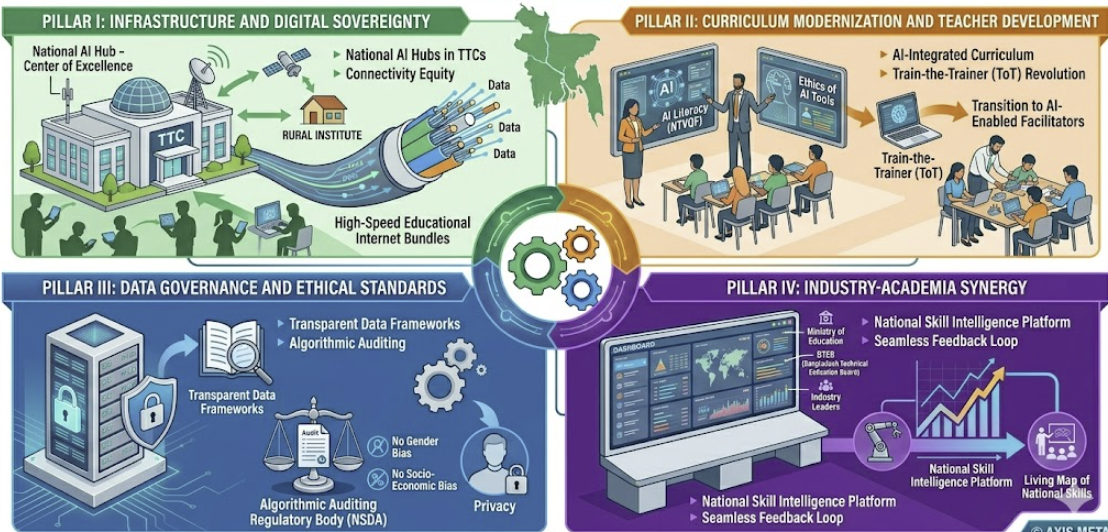
  • The Infrastructure Deficit: The fundamental prerequisite for AI is a robust, high-speed, and universally accessible digital infrastructure. While mobile penetration in Bangladesh is remarkably high, the quality of internet connectivity remains uneven, particularly in rural and remote geographical terrains like the Chittagong Hill Tracts or coastal belts. Furthermore, the development and deployment of complex AI models require massive computational power and affordable cloud hosting solutions (Roy, n.d.), which are currently scarce and prohibitively expensive for local startups and academic institutions. Reliable electricity, a basic necessity for running data centers, also remains a concern in certain regions.
  • The Human Capital and Skill Gap: The transition to a knowledge-based economy demands a highly skilled workforce. By 2030, Bangladesh will require over one million workers proficient in advanced digital skills (Roy, n.d.). Currently, the national education system and vocational training institutes are ill-equipped to meet this staggering demand. There is a profound scarcity of data scientists, machine learning engineers, and AI ethicists. Furthermore, there is a lack of AI literacy not just among the general public, but fundamentally among policymakers, regulatory agencies, and the judiciary, which severely hampers the formulation and implementation of data-driven policies.
  • Data Scarcity, Quality, and Sovereignty: Artificial Intelligence is entirely dependent on the data it is trained on. In Bangladesh, there is a critical shortage of comprehensive, high-quality, and structured localized datasets. For instance, the development of effective Natural Language Processing (NLP) tools requires massive corpora of the Bengali language, which are still in rudimentary stages compared to English. Moreover, the collection and utilization of data raise significant concerns regarding data sovereignty and privacy. Without robust data protection apparatuses, citizens are vulnerable to data breaches, unauthorized surveillance, and the exploitation of their personal information by commercial entities (Hossain, n.d.).
  • Algorithmic Bias and Ethical Dilemmas: AI systems are not infallible; they are highly susceptible to the biases present in their training data. If an AI system used for recruitment, loan approval, or judicial sentencing is trained on historically biased data, it will automate and scale discrimination. In the context of Bangladesh, ensuring that algorithms do not discriminate based on gender, socio-economic status, or geographical location is a paramount ethical challenge.

Strategic Recommendations: A Roadmap for the Future

To navigate these challenges and realize the vision of Smart Bangladesh, a multi-pronged, aggressive, and highly localized strategy must be deployed.

  • Investing in Foundational Infrastructure and Data Ecosystems: The government must prioritize the expansion of high-speed broadband to the deepest rural enclaves, treating internet access as a fundamental human right. Simultaneously, there must be state-backed investments in building national data centers and providing subsidized cloud computing resources for local researchers and startups. The government should also spearhead the creation of open-source, anonymized national datasets—particularly focusing on standardizing Bengali NLP resources—to spur indigenous AI research and development.
  • Radical Overhaul of the Education and Training Framework To avert a severe human capital crisis, the education system must be radically transformed. Coding, computational thinking, and basic AI literacy must be integrated into the primary and secondary school curricula. For the adult workforce, particularly in vulnerable sectors like the RMG industry, the government, in collaboration with the private sector, must launch massive, continuous reskilling and upskilling programs (Roy, n.d.). Furthermore, capacity-building programs must be instituted for regulatory agencies, judges, and civil servants to enhance their understanding of emerging technologies (Hossain, n.d.).
  • Enacting Comprehensive and Enforceable Legal Frameworks While the National Artificial Intelligence Policy 2024 is a positive step, Bangladesh urgently needs enforceable legislation akin to the GDPR to protect data privacy and ensure cybersecurity. These laws must clearly define the boundaries of data collection, mandate algorithmic transparency, and establish mechanisms for citizens to contest automated decisions. An independent AI regulatory body should be established to audit AI systems used in high-stakes areas like finance, healthcare, and the judiciary, ensuring they adhere to ethical guidelines such as UNESCO’s Recommendation on the Ethics of Artificial Intelligence (Taki, n.d.).
  • Fostering Regional Collaboration and Public-Private Partnerships Bangladesh cannot navigate the AI landscape in isolation. Regional collaboration with neighboring countries is essential to harmonize regulatory frameworks, pool technological resources, and ensure the interoperability of digital financial systems across borders (Hossain, n.d.). Domestically, the government must foster deep public-private partnerships (PPPs). The private sector possesses the agility and innovation required to build cutting-edge AI tools, while the government must provide the policy support, tax incentives, and regulatory sandboxes necessary for these tech ecosystems to thrive.
  • Prioritizing Inclusive AI Design Technology must be explicitly designed to serve the most vulnerable. AI development in Bangladesh must adopt a “bottom-up” approach, focusing on localized problem-solving. This means developing AI-powered agricultural extension services for remote farmers, introducing innovative weather-based crop insurance (Hossain, n.d.), and creating accessible tech for people with disabilities and marginalized communities. True smart development is measured not by the prosperity of the elite, but by the upliftment of those at the bottom of the socio-economic pyramid.

Conclusion: The Destiny of a Nation

The journey from a war-torn, agrarian society to “Smart Bangladesh 2041” is one of the most audacious national undertakings of our time. Digital transformation and the integration of Artificial Intelligence present an unprecedented opportunity to transcend historical limitations, eradicate systemic inefficiencies, and unlock the boundless potential of our human capital. However, AI is a dual-edged sword. Unregulated, it possesses the power to deepen the digital divide, displace the working class, and encode existing prejudices into the very fabric of our institutions.

As a nation, our strategy must be rooted in cautious optimism and aggressive preparation. We must reject the uncritical adoption of Western technological models and instead forge an indigenous path—one that marries cutting-edge innovation with our deeply held cultural values and socio-economic realities. The responsibility falls not just upon the government, but upon educators, technologists, private enterprises, and citizens alike to engage in this transformation critically and constructively. If we can successfully build the necessary infrastructure, cultivate a highly skilled workforce, enact rigorous ethical frameworks, and remain fiercely committed to absolute inclusivity, Bangladesh will not merely adapt to the future; it will lead it. The realization of Smart Bangladesh is not an inevitability, but a choice—a choice that demands visionary leadership, institutional integrity, and the enduring resilience that has always defined the Bangladeshi spirit.

References

  • Ahmed, T., Hasan, N., & Akter, R. (2023). Journey to Smart Bangladesh: Realities and Challenges. International Journal of Qualitative Research, 3(2), 178–187. https://doi.org/10.47540/ijqr.v3i2.980
  • Bashir, M. A. (n.d.). Artificial Intelligence (AI) E-Banking in Bangladesh: An Integrated Model of Consumer Decision-Making, Ethical Trust, and Fraud Prevention.
  • Digonta, A. I. K. (n.d.). Bangladesh University of Business and Technology (BUBT) Department of Law and Justice Research Monograph On.
  • Hossain, M. A. (n.d.). Digital Financial Technologies for Sustainable Development: The Bangladesh Perspective.
  • Karmaker, R. (n.d.). Policy, Risk and Innovation: A Mixed-Methods Framework for Using AI to Foster Inclusion in Marginalized Communities in Bangladesh.
  • Liang, Z. (n.d.). AI for the Next Generation of Public Services.
  • Roy, A. (n.d.). Artificial Intelligence in Advanced Manufacturing: Opportunities, Applications, and Challenges in the Context of Bangladesh.
  • Sultana, O. (n.d.). Indiana Journal of Economics and Business Management Research Article Smart Bangladesh: Bridging Technology and Economy for a Br.
  • Taki, M. K. (n.d.). Artificial Intelligence in Bangladesh’s Legal System: Pathways to Smart and Efficient Justice.

Artificial Intelligence and TVET: A Policy Guidance Framework for Bangladesh

Bangladesh stands at a pivotal junction where the integration of Artificial Intelligence (AI) into the Technical and Vocational Education and Training (TVET) sector is no longer a futuristic aspiration, but an immediate developmental imperative. As the nation pivots toward Vision 2041, the synergy between AI and vocational training offers a transformative pathway to bridge the persistent skills mismatch, personalize learning, and modernize administrative efficiency. However, the path to AI adoption is fraught with systemic hurdles, including infrastructure deficits, a digital divide, and a lack of regulatory clarity. This article serves as a strategic policy guidance framework for Bangladeshi policymakers, articulating a roadmap for the responsible, inclusive, and effective integration of AI into the national TVET ecosystem.

Introduction: The AI Paradigm Shift in Vocational Education

The global labor market is undergoing a seismic shift driven by the Fourth Industrial Revolution. In Bangladesh, where the youth bulge represents our greatest economic asset, the traditional TVET model—often characterized by rigid curricula and analog delivery—must evolve rapidly to remain relevant. Artificial Intelligence has emerged as the defining technology of this era, offering tools that can hyper-personalize skill acquisition, automate administrative bottlenecks, and align training outcomes with the real-time demands of the modern industry.

For policymakers in Bangladesh, the challenge is twofold: how to harness AI to accelerate the productivity of the workforce, and how to protect the integrity of the education system against algorithmic bias and data privacy risks. This guidance framework proposes a transition from reactive, isolated pilot projects to a unified, national AI-in-TVET strategy.

The Strategic Value Proposition of AI in TVET

AI integration in TVET is not about replacing human trainers; it is about augmenting their impact and creating “smarter” training environments.

  • Adaptive and Personalized Learning: AI-powered Intelligent Tutoring Systems (ITS) can analyze individual student performance in real-time, adjusting the complexity of learning materials based on their unique learning pace and style. This is particularly transformative for competency-based training where mastery is the objective.

  • Predictive Labor Market Alignment: By leveraging Big Data and Natural Language Processing (NLP), AI systems can scrape job market data, identify emerging skill clusters, and alert curriculum developers to update modules before they become obsolete.

  • Virtual and Augmented Simulations: In trades like electrical installation, automotive repair, or heavy machinery operation, AI-driven simulators provide students with risk-free environments to practice complex procedures, significantly reducing the cost of equipment wear and tear.

  • Administrative Automation: Automating student enrollment, tracking certification progress, and facilitating BTEB-linked assessment workflows can liberate trainers from bureaucratic tasks, allowing them to focus on pedagogical mentorship.

Policy Pillars for AI-Driven TVET Reform

To successfully institutionalize AI in the Bangladeshi TVET sector, the government should adopt a four-pillar policy framework.

Pillar I: Infrastructure and Digital Sovereignty

Bangladesh must bridge the urban-rural digital divide to ensure equitable AI access. Policies should prioritize:

  • National AI Hubs: Establishing dedicated AI-enabled “Centers of Excellence” within existing Technical Training Centers (TTCs) that serve as regional resource centers for rural institutes.

  • Connectivity Equity: Implementing subsidized, high-speed educational internet bundles for registered VET learners and institutions to ensure that digital training materials are accessible nationwide.

Pillar II: Curriculum Modernization and Teacher Development

Technology is only as effective as the hands that wield it.

  • AI-Integrated Curriculum: AI literacy must be embedded across all NTVQF levels, teaching not just how to use AI, but how to understand the ethical implications of the tools being used.

  • Train-the-Trainer (ToT) Revolution: A massive, nationwide upskilling campaign is needed to transition instructors from traditional lecturers to AI-enabled facilitators. This requires specialized training in digital pedagogy and the use of AI-based assessment platforms.

Pillar III: Data Governance and Ethical Standards

As AI relies on data, its misuse can lead to algorithmic bias and privacy infringements.

  • Transparent Data Frameworks: Developing clear guidelines on how student data—such as performance analytics and behavioral patterns—is collected, stored, and used.

  • Algorithmic Auditing: Establishing a regulatory body, potentially under the NSDA or a central AI office, to periodically audit AI platforms used in education to ensure they do not exhibit gender or socio-economic bias.

Pillar IV: Industry-Academia Synergy

AI enables a seamless feedback loop between the factory and the classroom.

  • National Skill Intelligence Platform: Creating a centralized, AI-driven dashboard that connects the Ministry of Education, BTEB, and industry leaders, providing a living map of the national skills landscape.

Addressing Implementation Challenges

Policymakers must remain cognizant of the constraints inherent in the Bangladeshi context:

  1. The Skill Gap: There is an acute shortage of domestic AI talent capable of building localized tools. Policies should incentivize domestic startups to focus on vernacular AI (Bangla-language support) for TVET.

  2. Resource Constraints: High-performance computing is expensive. A pragmatic approach involves “Light AI”—prioritizing cloud-based, mobile-friendly AI solutions that do not require specialized hardware in every classroom.

  3. Social Resistance: There is a lingering stigma regarding vocational education. AI-driven TVET should be marketed as a high-tech, modern pathway that provides a competitive edge in the global digital economy.

A Phased Implementation Roadmap

For sustainable growth, I recommend a phased approach:

  • Phase 1 (Short-term): Focus on AI-assisted tools for trainers (e.g., automated lesson planning tools like TeacherMatic, assessment grading support) to immediately reduce workload and familiarize staff with AI.

  • Phase 2 (Medium-term): Pilot adaptive learning platforms in high-demand trades like ICT and Renewable Energy, using the insights gained to scale these systems to other sectors.

  • Phase 3 (Long-term): Integrate AI into national-level assessment and certification frameworks, establishing a fully digitized, real-time responsive skill development ecosystem.

Conclusion

The integration of AI into TVET is the most significant opportunity for Bangladesh to leapfrog traditional development bottlenecks. By creating a policy environment that emphasizes human-centric AI, ensures inclusivity, and promotes responsible innovation, Bangladesh can transform its TVET sector into a world-class engine of economic growth. As a TVET expert, I urge our policymakers to act with boldness, ensuring that no student is left behind in the transition to the digital future.

About the Author

Khan Mohammad Mahmud Hasan is a distinguished TVET Expert, curriculum specialist. With over 20 years of experience in leading systemic reforms across the national skills ecosystem, he specializes in bridging the gap between educational theory and industrial reality. His work, which spans international agency-funded projects like those of the ILO, GIZ, and the World Bank, is dedicated to modernizing TVET through technology, behavioral psychology, and evidence-based career counseling. He is a passionate advocate for digital upskilling and the ethical integration of emerging technologies to empower the Bangladeshi workforce. Visit his website for details.

Addressing Skills Mismatching in the Green Sector Through Digital Upskilling of VET in Bangladesh

Bangladesh is navigating a profound economic transition, characterized by rapid industrialization, graduation from Least Developed Country status, and acute vulnerability to climate change. As the nation pivots toward a sustainable economic model, a critical challenge has emerged, a severe skills mismatch within the burgeoning green sector. While industries increasingly demand technical proficiency in renewable energy, sustainable manufacturing, and climate-adaptive agriculture, the traditional Vocational Education and Training (VET) ecosystem struggles to supply graduates equipped with these modern competencies. This article explores the systemic integration of digital upskilling as the primary catalyst for resolving this disparity. By digitizing Competency-Based Training and Assessment (CBT&A) frameworks, creating blended learning pathways, and leveraging digital pedagogy, the VET sector can rapidly modernize its curriculum to meet green industry standards. Drawing on practical implementation models, this comprehensive analysis outlines the strategic framework necessary to cultivate a climate-resilient, digitally fluent workforce capable of driving the future of Bangladesh.

Introduction, The Crossroads of Bangladesh’s Economic Evolution

As Bangladesh sets its trajectory toward becoming a developed nation by the year 2041, the fundamental architecture of its economy is experiencing a massive paradigm shift. Central to this ambitious Vision 2041 is the optimization of human capital. Every year, millions of young men and women enter the local labor market, seeking viable employment opportunities. However, the nation is simultaneously confronting the existential threat of global climate change. Rising sea levels, shifting weather patterns, and the demand for environmental compliance in global supply chains have necessitated a structural pivot toward a green economy.

This transition presents an unprecedented opportunity for job creation. Investments in solar energy, wind power, sustainable garment manufacturing, and climate-adaptive agriculture are generating new occupational categories. Yet, a glaring disconnect remains. The industries driving this green transition frequently report an inability to find workers with the requisite technical skills. Conversely, thousands of graduates from traditional educational streams face persistent unemployment or underemployment. This phenomenon, widely recognized as skills mismatching, threatens to bottleneck national progress.

Resolving this crisis demands an urgent modernization of the Technical and Vocational Education and Training (TVET) sector. Traditional vocational training, while historically foundational, is often characterized by outdated curricula, analog delivery methods, and a disconnect from real-time industrial demands. To bridge the green skills gap, the VET ecosystem must undergo a comprehensive digital transformation. Digital upskilling of both instructors and learners is no longer an optional enhancement, it is an absolute necessity. By embracing digital pedagogy, online learning management systems, and interactive assessment tools, VET institutions can rapidly disseminate complex green competencies across urban centers and remote rural upazilas alike.

Deconstructing the Skills Mismatch in Bangladesh

The skills mismatch in Bangladesh is a multifaceted problem that operates on several simultaneous levels. At its core, the mismatch occurs when the qualitative output of the educational system fails to align with the quantitative and qualitative demands of the labor market. In the context of the green sector, this discrepancy is particularly pronounced.

Firstly, there is an informational mismatch. Many VET institutions operate in isolation from the industries they are meant to serve. Curriculum developers often rely on historical occupational standards rather than actively analyzing emerging market trends. As a result, students may spend years mastering trades that are becoming obsolete due to automation or environmental regulations, while critical areas like photovoltaic installation or sustainable waste management remain absent from the syllabus.

Secondly, a severe pedagogical mismatch exists. Even when green topics are introduced, they are frequently taught using outdated, rote-learning methodologies. A student might memorize the theory behind an energy-efficient cooling system but lack the hands-on, practical competency to install or repair it in a real-world karkhana or factory setting. This lack of applied skill renders the graduate unemployable in the eyes of an industry that demands immediate productivity.

Thirdly, the mismatch extends to behavioral and digital competencies. Modern green jobs require more than just manual dexterity. They demand cognitive flexibility, problem-solving abilities, and a foundational understanding of digital interfaces. A technician maintaining a smart solar grid must be able to interact with diagnostic software and interpret digital data streams. When VET graduates lack these integrated digital soft skills, they are unable to adapt to the rapidly evolving technological landscape of the green economy.

The Emergence of the Green Economy and Green Jobs

To effectively address the skills gap, it is imperative to define the parameters of the green economy within the localized context of Bangladesh. The green economy is not a monolithic sector, rather, it is a broad operational philosophy that permeates various traditional industries while also creating entirely new technological fields.

In Bangladesh, the transition is most visible in the energy sector. The government’s commitment to increasing the share of renewable energy in the national power grid has catalyzed the deployment of solar home systems, large-scale solar parks, and localized biogas plants. Each of these installations requires a specialized workforce for manufacturing, installation, maintenance, and eventual recycling. These are the quintessential green jobs, roles that directly contribute to preserving or restoring environmental quality.

However, the green economy extends far beyond renewable energy. The Ready-Made Garments (RMG) sector, the backbone of the national export economy, is undergoing a massive sustainability overhaul. International buyers and regulatory bodies are imposing strict compliance standards regarding water usage, effluent treatment, and carbon emissions. Consequently, there is a surging demand for VET graduates who understand sustainable textile processing, chemical management, and energy auditing.

Furthermore, in the agricultural domain, the shifting climate necessitates a transition from traditional farming to climate-adaptive agriculture. This involves precision irrigation, organic soil management, and the use of solar-powered agricultural machinery. The VET sector must therefore broaden its definition of vocational training to include these modern, ecologically sustainable practices, ensuring that the rural workforce is equipped to secure their livelihoods in a changing climate.

The Anatomy of Green Skills in the Local Context

Understanding green jobs requires a granular analysis of the specific green skills they entail. Green skills can be broadly categorized into two distinct types, technical green skills and generic green skills. Both are essential for a holistic VET curriculum.

Technical green skills are occupation-specific competencies. For a solar technician, this includes the ability to calculate optimal panel tilt, wire inverters safely, and troubleshoot battery storage systems. For an automotive mechanic, it involves the competency to service electric vehicles (EVs), safely handle high-voltage battery packs, and manage the disposal of toxic components. These skills require dedicated, hands-on training using modern equipment that reflects current industry standards.

Conversely, generic green skills are transversal competencies that apply across all occupations. These include environmental awareness, resource efficiency, and carbon footprint reduction. A conventionally trained mason or carpenter must possess the generic green skill of material optimization to minimize waste during construction. An administrative worker must understand digital workflows to reduce paper consumption and energy use in the office.

The challenge for the Bangladeshi VET system lies in integrating both categories simultaneously. The curriculum must be modular enough to introduce entirely new technical green qualifications while also retrofitting existing traditional courses with generic green modules. This dual approach ensures that every VET graduate, regardless of their specific trade, enters the labor market as a conscious contributor to the green transition.

The Traditional VET Ecosystem, Strengths and Limitations

The existing VET infrastructure in Bangladesh provides a substantial foundation upon which to build. Governed by the National Skills Development Authority (NSDA) and the Bangladesh Technical Education Board (BTEB), the system encompasses hundreds of Technical Training Centers (TTCs), polytechnic institutes, and private training providers. The establishment of the National Technical and Vocational Qualifications Framework (NTVQF) has standardized certification, providing a transparent pathway for skills recognition.

Despite these structural strengths, the traditional ecosystem is hindered by several critical limitations. Foremost among these is the lack of physical and technical resources. Many training centers, particularly in rural upazilas, operate with outdated machinery that bears little resemblance to the equipment currently utilized by modern industries. It is virtually impossible to teach advanced green skills, such as maintaining a computerized industrial effluent treatment plant, using analog tools from a previous decade.

Additionally, the sector faces a severe shortage of qualified instructional staff. The instructors themselves often lack exposure to the latest technological advancements and green practices. Without a systemic mechanism for the continuous professional development of trainers, the curriculum remains stagnant.

Finally, traditional VET delivery is heavily reliant on synchronous, in-person instruction. This model is inherently difficult to scale and is highly vulnerable to disruptions. The rigidity of fixed classroom schedules also excludes many potential learners, such as working adults seeking to upskill or women with domestic responsibilities. To overcome these limitations, the system must pivot toward digital delivery mechanisms.

Digital Upskilling, The Catalyst for VET Modernization

Digital upskilling serves as the bridge connecting the outdated traditional VET model with the dynamic demands of the green economy. It involves equipping both the instructional faculty and the student body with the digital literacy and technological tools necessary to facilitate modern learning.

For the VET learner, digital upskilling begins with basic computer literacy but rapidly advances to utilizing industry-specific software. A modern draftsperson must master Computer-Aided Design (CAD) software to create energy-efficient architectural plans. A logistics student must learn to use supply chain management platforms to optimize delivery routes and reduce carbon emissions. By embedding digital tools directly into the vocational curriculum, the system produces graduates who are fluent in the language of modern industry.

For the VET institution, digital upskilling involves a radical overhaul of pedagogical delivery. The deployment of comprehensive Learning Management Systems (LMS) allows for the implementation of blended learning models. Theoretical components of a green skill, such as the principles of thermodynamics or environmental safety regulations, can be delivered via interactive online modules, video lectures, and digital quizzes. This frees up valuable physical workshop time, allowing instructors to focus exclusively on hands-on practical demonstrations and assessments.

Digital platforms also democratize access to premium training. A localized training center in a remote zila may not have a resident expert in wind turbine maintenance, but through digital connectivity, students can participate in virtual masterclasses led by national or international specialists. This geographical flexibility is essential for scaling green skills rapidly across the entire country.

Designing a Digitally Integrated Green VET Curriculum

The creation of a digitally integrated green curriculum requires a departure from traditional textbook-based syllabus design. The process must be dynamic, responsive, and deeply rooted in the principles of Competency-Based Training and Assessment (CBT&A).

The first step is conducting granular occupational mapping in collaboration with green industry leaders. This involves identifying the precise tasks a worker must perform on the job and breaking those tasks down into discrete elements of competency. For instance, the competency standard for a solar technician must explicitly detail the steps for safe installation, performance testing, and digital monitoring of the system.

Once the competency standards are established, the curriculum developers must design Competency-Based Learning Materials (CBLM) that leverage digital media. Instead of relying solely on static printed manuals, modern CBLMs should incorporate augmented reality (AR) and virtual reality (VR) simulations. These digital tools are particularly transformative for green VET. A student can practice wiring a complex solar array or repairing a high-voltage electric vehicle battery in a risk-free virtual environment before ever touching live equipment. This not only enhances safety but also drastically reduces the material costs associated with training.

Furthermore, the curriculum must embed generic digital and green skills across all modules. Even a basic masonry course delivered via a digital platform should include modules on calculating the carbon footprint of cement and utilizing digital tools for precise material estimation. This integrated approach ensures a holistic educational experience.

Competency-Based Training and Assessment (CBT&A) in the Digital Age

The philosophy of CBT&A is the cornerstone of modern vocational education. It shifts the focus from the duration of learning, how many hours a student sat in a classroom, to the demonstration of practical capability, what the student can actually do. Digital technology exponentially enhances the efficacy and transparency of the CBT&A model.

In a traditional assessment, an examiner observes a student performing a task and fills out a paper-based evaluation form. This process is inherently subjective and difficult to audit. By digitizing the assessment process, VET institutions can introduce unprecedented levels of rigor and quality assurance. Digital assessment platforms can utilize video evidence, where a student records their practical demonstration of a green skill, such as assembling a biogas valve, and uploads it to the LMS. Certified assessors can then review the footage, pausing and evaluating specific techniques against the standardized criteria.

Moreover, digital CBT&A allows for adaptive learning pathways. Not all students learn at the same pace. A digital LMS can track a learner’s progress through theoretical green modules, identifying areas of weakness and automatically providing supplementary digital resources before the student attempts the final practical assessment.

The ultimate goal of digitized CBT&A is the creation of a verifiable digital credential, such as an e-portfolio or a blockchain-backed digital badge. When a graduate approaches a green energy company for employment, they do not merely present a piece of paper, they provide a digital link showcasing verified video evidence of their technical competencies, drastically increasing employer confidence and bridging the skills mismatch.

The Crucial Role of Industry-VET Partnerships

No VET system can operate effectively in an academic vacuum. The eradication of the skills mismatch depends entirely on the establishment of robust, institutionalized partnerships between training providers and the private sector. The Industry Skills Councils (ISCs) serve as the primary mechanism for this collaboration in Bangladesh.

In the context of the green economy, ISCs representing renewable energy, sustainable agriculture, and eco-friendly manufacturing must take a proactive role in shaping the VET ecosystem. This involvement must extend far beyond occasional advisory board meetings. Industry partners must be intimately involved in the granular development of competency standards, ensuring that the curriculum accurately reflects the technologies currently utilized on the factory floor.

Furthermore, industry partnerships are essential for overcoming the physical resource limitations of VET institutions. Through public-private partnerships, companies can donate modern green equipment, such as decommissioned wind turbine components or advanced diagnostic software, to local TTCs.

Most importantly, the industry must facilitate extensive apprenticeship and workplace learning programs. A student studying sustainable effluent treatment cannot fully master the competency within a simulated classroom environment. They require structured, supervised experience within an operational facility. By committing to offering structured apprenticeships, the green industry ensures a steady pipeline of highly trained, digitally fluent technicians ready for immediate formal employment.

Localizing the Approach, Perspectives from Cox’s Bazar and Beyond

While national frameworks provide the structural foundation, the implementation of green and digital VET must be highly adaptable to localized socio-economic realities. Interventions that succeed in the industrial hubs of Dhaka may not be appropriate for vulnerable regions. The complex environment of Cox’s Bazar serves as a prime example of the need for localized VET strategies.

The geographical and demographic landscape of Cox’s Bazar has been dramatically altered by massive population influxes, placing severe strain on local resources, the environment, and the livelihoods of host communities. In such fragile economies, addressing the skills mismatch requires a hyper-local approach. VET initiatives must prioritize rapid, market-driven skills delivery that generates immediate income while promoting environmental restoration.

In these regions, green skills training must focus on community-level sustainability. This includes training youth in the installation of decentralized solar micro-grids, sustainable forestry management to combat deforestation, and climate-adaptive agricultural techniques suitable for the local topography.

Digital upskilling in such environments must be pragmatic. It may involve teaching local entrepreneurs how to use mobile-based digital platforms for mobile financial services, supply chain logistics, and accessing weather data for agricultural planning. By tailoring the green and digital VET interventions to the specific ecological and economic needs of the upazila, development projects can foster localized resilience, alleviate social tension, and create sustainable pathways out of poverty.

Fostering Entrepreneurship and Micro-Enterprises in the Green Sector

The assumption that the ultimate goal of VET is strictly formal corporate employment is fundamentally flawed, particularly in a developing economy characterized by a vast informal sector. A comprehensive VET strategy must actively foster youth entrepreneurship and support the creation of micro-enterprises within the green economy.

Technical mastery of a green trade, such as solar panel repair or organic farming, does not inherently equip an individual with the business acumen required to run a profitable enterprise. Therefore, applied entrepreneurship modules must be deeply integrated into the digital green VET curriculum.

These modules must move beyond theoretical economics, teaching students practical, localized business skills. Utilizing digital platforms, students must learn how to conduct digital market research, manage basic accounting using mobile applications, and utilize social media for digital marketing.

Crucially, the VET ecosystem must act as a facilitator, bridging the gap between training and enterprise launch. This involves establishing linkages between graduates and microfinance institutions or green venture funds, helping young tradespeople secure the initial capital required to purchase equipment. By cultivating a mindset shift from seeking jobs to creating jobs, the digitally empowered green VET system can trigger decentralized economic growth, fostering a network of sustainable micro-enterprises across the nation.

 Overcoming Implementation Bottlenecks

The transition to a digitally upskilled, green VET ecosystem is fraught with significant implementation challenges that must be systematically addressed. Foremost among these is the stark digital divide. While mobile internet penetration is high in Bangladesh, access to the high-speed broadband and capable computing devices required for advanced digital VET remains limited, particularly in rural upazilas. Relying solely on sophisticated digital platforms risks excluding the most vulnerable populations from the green transition.

To mitigate this, VET infrastructure development must include the establishment of community-based digital learning hubs equipped with reliable internet and devices. Furthermore, digital learning materials must be optimized for mobile devices and designed to function effectively in low-bandwidth environments, utilizing offline-capable applications where necessary.

Another critical bottleneck is the resistance to pedagogical change among existing instructional staff. Shifting from the role of a traditional lecturer to a digital facilitator requires a profound professional transformation. A massive, systemic Training of Trainers (ToT) initiative is required. This ToT program must not only impart technical knowledge about renewable energy or sustainable practices but must heavily emphasize digital pedagogy, behavioral psychology, and adaptive instructional strategies.

Finally, there is a pervasive social stigma associated with vocational education. Despite the high earning potential of modern green jobs, society often views VET as a secondary option for those who fail in the general academic stream. Overcoming this requires sustained national awareness campaigns, utilizing digital media to highlight the prestige, technical sophistication, and financial viability of careers in the green economy.

Policy Recommendations for Sustainable Transformation

To ensure the successful eradication of the skills mismatch through digital upskilling, a cohesive and aggressive policy framework is required. Policymakers and national stakeholders must commit to a coordinated, multi-sectoral approach.

First, the government must mandate the integration of green competencies across all NTVQF levels. Environmental sustainability can no longer be an elective subject, it must be a core competency required for certification in every trade, from garments manufacturing to construction.

Second, massive public and private investment must be directed toward the digital infrastructure of VET institutions. This includes not only the procurement of hardware but the development of a centralized, national Learning Management System accessible to all recognized training providers. The government should also incentivize telecommunications companies to provide subsidized data packages explicitly for registered VET learners accessing educational content.

Third, the governance of the VET sector must become more agile. The process of updating competency standards and approving new curricula often takes years, by which time the technology has evolved. The BTEB and NSDA must establish rapid-response mechanisms, working continuously with ISCs to update green digital curricula in real-time, ensuring the system remains responsive to industry needs.

Fourth, comprehensive career counseling and behavioral assessment must be institutionalized within every training center. Utilizing digital profiling tools, counselors must guide students into the green trades that best align with their natural aptitudes, drastically reducing dropout rates and improving long-term job satisfaction.

Conclusion

Bangladesh stands at a critical juncture in its economic and environmental history. The dual imperatives of graduating from LDC status and mitigating severe climate vulnerability demand a workforce that is not only technically proficient but inherently adaptable, digitally literate, and ecologically conscious. The persistence of skills mismatching in the green sector is a structural impediment that traditional educational paradigms can no longer resolve.

The systemic digital upskilling of the Technical and Vocational Education and Training sector represents the most viable pathway forward. By embracing Competency-Based Training and Assessment, integrating specialized green curricula, and forging unbreakable alliances with the private sector, the VET ecosystem can transform from an analog institution into a dynamic engine of economic resilience. The transition to a green economy is inevitable, but its success depends entirely on the hands and minds of the workforce driving it. Through strategic, digitally empowered vocational education, Bangladesh can secure its future as a prosperous, sustainable, and globally competitive nation.

About the Author

Khan Mohammad Mahmud Hasan is a highly distinguished Technical and Vocational Education and Training (TVET) expert, curriculum specialist, and master trainer based in Bangladesh. With over 20 years of experience, he operates at the crucial intersection of education, policy, and workforce transformation. He is a recognized authority in the implementation of Competency-Based Training and Assessment (CBT&A) methodologies and a passionate advocate for the integration of Green TVET and advanced digital pedagogy.

For more information on him, visit his Website