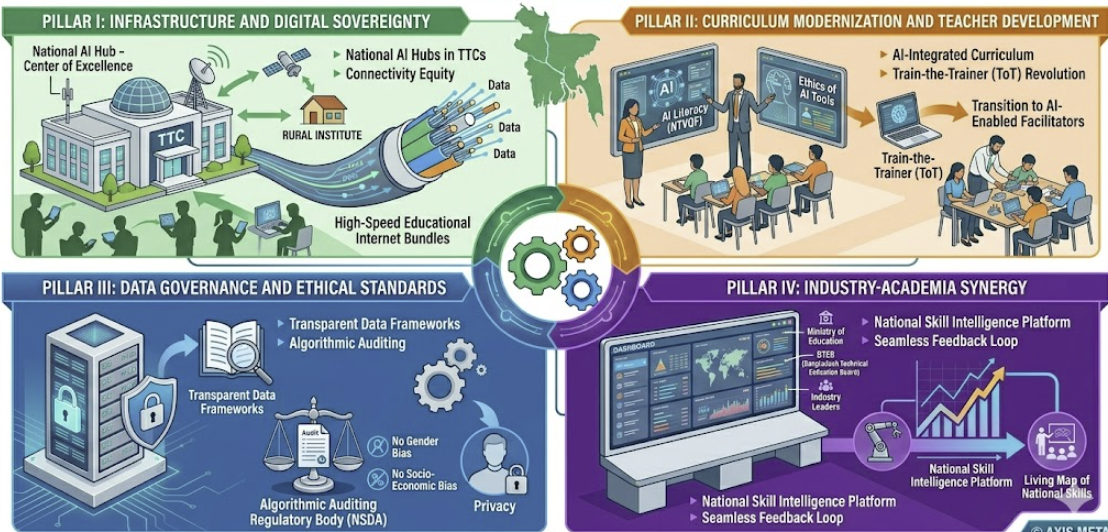
Bangladesh is currently navigating a profound demographic transition, presenting an unprecedented opportunity to leverage its youth bulge for accelerated economic growth. However, realizing this potential requires a structural departure from traditional educational paradigms toward a highly responsive, industry-aligned Technical and Vocational Education and Training (TVET) ecosystem. This article provides a comprehensive exploration of the Theory of Change (ToC) necessary to drive systemic reform within the Bangladeshi TVET sector. By mapping the causal pathways from initial resource inputs to ultimate socio-economic impact, the framework addresses critical components such as Competency-Based Training and Assessment (CBT&A), the integration of Green TVET, localized crisis responses in regions like Cox’s Bazar, and the imperative of robust career counseling. Ultimately, this article argues that sustainable workforce development relies not merely on the proliferation of training centers, but on a holistic, evidence-based strategy that inextricably links technical competency with long-term economic resilience.
Introduction, The Critical Juncture of Skills Development in Bangladesh
As Bangladesh approaches its graduation from the Least Developed Country (LDC) category in 2026 and sets its sights on achieving developed nation status by 2041, the nation’s economic architecture is undergoing a massive transformation. Central to this transition is the optimization of human capital. Every year, more than two million young people enter the Bangladeshi labor market. While general education has historically been the default pathway, the escalating demand for specialized, technical skills has exposed the limitations of traditional academic degrees. A profound skills mismatch currently exists, where industries struggle to find competent workers while university graduates face alarming rates of underemployment.
To address this disparity, the Government of Bangladesh, guided by the Technical and Madrasah Education Division (TMED) and various national stakeholders, has prioritized the expansion and modernization of the TVET sector. However, building infrastructure and increasing enrollment numbers are only the initial steps. True sectoral reform requires a rigorous methodology to ensure that the training delivered translates directly into decent work, poverty reduction, and national productivity. This is where the Theory of Change becomes indispensable. It provides the strategic roadmap, detailing exactly how specific educational interventions will trigger the systemic transformations required to build a globally competitive workforce.
Deconstructing the Theory of Change in the TVET Sector
A Theory of Change is not merely an administrative document or a basic logical framework. It is a comprehensive illustration of the causal linkages that explain how and why a desired change is expected to occur in a specific context. In the realm of TVET, the ToC forces policymakers, curriculum developers, and master trainers to shift their focus from tracking basic activities, such as the number of classes held, to measuring actual, life-altering outcomes.
The logic model operates sequentially, ensuring that every resource utilized has a direct line of sight to the ultimate economic goal. If a project aims to elevate the livelihood of youth in a rural upazila, the ToC maps the journey backward from that goal to the present day, identifying the necessary conditions for success.
The fundamental pillars of the TVET Theory of Change in Bangladesh can be categorized as follows:
| Stage | Definition | Application in Bangladesh TVET |
| Inputs | The foundational resources invested. | Government funding, donor investments, occupational standards, master trainers, physical infrastructure in TTCs and polytechnic institutes. |
| Activities | The operational actions executed. | Conducting Training of Trainers (ToT), developing Competency-Based Learning Materials (CBLM), establishing Industry Skills Councils (ISCs). |
| Outputs | The immediate, tangible deliverables. | Number of youths securing BTEB certification, number of active centers of excellence, published session plans and assessment tools. |
| Outcomes | The medium-term changes in status. | Graduates securing formal employment, youths launching entrepreneurial ventures, industries adopting standardized competency metrics. |
| Impact | The long-term systemic change. | Sustained poverty reduction, transition to a climate-adaptive green economy, realization of Vision 2041 economic targets. |
Through this matrix, stakeholders can identify potential points of failure. For example, if a program generates a high volume of certified outputs but fails to achieve employment outcomes, the ToC highlights a breakdown in industry linkage or career counseling, prompting immediate strategic correction.
The Institutional Architecture and Policy Framework
For a Theory of Change to be effective, it must be embedded within a robust institutional framework. In Bangladesh, the governance of skills development has evolved significantly to accommodate the complexities of a modern economy. The National Skills Development Authority (NSDA), operating under the Prime Minister’s Office, serves as the apex body for policy coordination, standard-setting, and quality assurance across the nation.
Working in tandem with the NSDA is the Bangladesh Technical Education Board (BTEB), which retains the critical mandate for curriculum development, assessment regulation, and the certification of both learners and instructors. The cornerstone of this regulatory environment is the National Technical and Vocational Qualifications Framework (NTVQF). The NTVQF categorizes skills into distinct levels, ranging from basic pre-vocational capabilities up to advanced diploma levels, ensuring that qualifications are standardized, transparent, and nationally recognized.
Furthermore, the Theory of Change relies heavily on the active participation of the private sector, facilitated through Industry Skills Councils (ISCs). These councils ensure that the competency standards developed by the BTEB are not created in an academic vacuum but are directly derived from real-time market demands. By integrating industry leaders into the curriculum design phase, the TVET sector ensures that its ultimate outputs, the skilled graduates, are precisely what the employers require. Additionally, the system embraces the informal economy through the Recognition of Prior Learning (RPL) mechanism, allowing experienced but uncertified workers to gain formal NTVQF credentials, thereby formalizing their expertise and enhancing their earning potential.
Competency-Based Training and Assessment (CBT&A), The Pedagogical Engine
The most profound paradigm shift within the Bangladeshi TVET sector has been the transition from time-bound, rote-learning models to Competency-Based Training and Assessment (CBT&A). In a traditional system, a student spends a fixed amount of time in a classroom and passes a written exam. In the CBT&A model, time is a variable and competency is the constant. The primary focus is on what the learner can actually do in a real-world workplace setting.
The ToC relies on CBT&A as its primary activity engine. The methodology mandates the development of rigorous Competency Standards (CS) for every specific occupation, breaking down complex trades into modular elements of competency. Instructors, acting as facilitators rather than traditional teachers, utilize Competency-Based Learning Materials (CBLM) to guide students through practical demonstrations of skill.
This model places immense responsibility on the shoulders of the educators. Consequently, developing a cadre of highly skilled Master Trainers and BTEB-certified Assessors is a critical input. These professionals must possess not only deep technical knowledge but also advanced pedagogical skills to manage varied learning paces and conduct evidence-based assessments. When an assessor signs off on a student’s competency, they are providing a guarantee to the industry that the individual can perform the specific occupational tasks safely and efficiently. This rigorous quality assurance is what ultimately drives employer trust and secures the desired employment outcomes.
Green TVET and Climate-Adaptive Skills
Bangladesh stands uniquely vulnerable to the impacts of global climate change. As the nation industrializes, it faces the dual challenge of expanding its manufacturing capacity while minimizing environmental degradation. Therefore, a modern Theory of Change for TVET cannot merely focus on traditional trades, it must proactively integrate environmental sustainability. This imperative has given rise to the concept of Green TVET.
Green TVET involves a systemic overhaul of the curriculum to foster a carbon-conscious workforce. It operates on two distinct fronts. First, it involves the creation of entirely new occupational standards for emerging green sectors. As international initiatives and projects spearhead the transition to renewable energy, there is an urgent need for technicians skilled in solar panel installation, wind turbine maintenance, and biogas plant operations.
Second, Green TVET requires the integration of sustainable practices into existing, traditional trades. A conventionally trained mason must learn sustainable construction techniques and material optimization. A garments worker must understand waste reduction, chemical management, and energy efficiency on the factory floor. By training instructors on climate-adaptive pedagogies, the TVET system ensures that the next generation of technicians will enter the workforce equipped to drive the nation’s transition to a green economy, fulfilling a critical long-term impact metric.
Localizing Interventions, A Focus on Cox’s Bazar and Fragile Economies
While national frameworks provide the structural foundation, a successful Theory of Change must be highly adaptable to localized socio-economic realities. Interventions that succeed in the industrial hubs of Dhaka or Gazipur may fail in rural or crisis-affected districts. A prime example of this necessity is the implementation of skills programs in Cox’s Bazar zila.
The geopolitical landscape of Cox’s Bazar has been dramatically altered by the massive influx of displaced populations, placing immense strain on the local economy, infrastructure, and the livelihoods of the host communities. In such fragile environments, a generic approach to vocational training is insufficient. Projects aimed at improving skills and employment in these specific upazilas require a deeply contextualized ToC.
Interventions here must prioritize rapid, market-driven skills delivery that can generate immediate income and alleviate social tension. The focus often shifts toward agriculture-tech, localized supply chain logistics, specialized hospitality services, and light engineering trades that serve the immediate logistical needs of the region. By conducting hyper-local labor market assessments and partnering with regional enterprises, TVET initiatives can bypass broader national bottlenecks and create direct pipelines from training centers to local employment, fostering economic resilience and social cohesion in highly volatile areas.
Bridging the Gap, Career Counseling and Behavioral Assessment
A critical vulnerability in many historical TVET projects has been the assumption that producing a certified graduate automatically results in employment. This gap between the output (certification) and the outcome (job placement) is where many well-intentioned programs falter. To solidify this crucial link in the ToC, institutions must integrate comprehensive career counseling and behavioral support systems directly into the training lifecycle.
The modern job market demands more than just technical proficiency, it requires distinct behavioral competencies, emotional resilience, and professional adaptability. Innovative approaches, such as establishing dedicated career centers and utilizing advanced placement frameworks, are essential. By integrating psychometric testing and behavioral profiling, institutions can align a student’s natural aptitudes with the appropriate trade, drastically reducing dropout rates and future job dissatisfaction.
Furthermore, implementing structured employability scoring provides prospective employers with a holistic view of a candidate, encompassing both their BTEB-certified technical skills and their communication, teamwork, and problem-solving abilities. When career counseling is treated as a core curriculum component rather than an optional afterthought, the TVET system effectively transforms job seekers into highly desirable industry assets, cementing the ultimate outcomes of the Theory of Change.
Fostering Youth Entrepreneurship
The assumption that all TVET graduates will enter formal employment is fundamentally flawed, particularly in a developing economy with a vast informal sector and limited corporate absorption capacity. A robust Theory of Change must acknowledge and actively support self-employment and micro-enterprise development as primary outcome pathways.
Fostering entrepreneurship requires a deliberate pedagogical strategy. Technical mastery of a trade, such as refrigeration repair or specialized tailoring, does not inherently equip an individual with the business acumen required to run a profitable enterprise. Therefore, applied entrepreneurship modules must be woven into the core CBT&A curriculum.
These modules must go beyond basic theory, teaching students practical skills in localized market analysis, supply chain management, digital marketing, and financial literacy. Crucially, the TVET ecosystem must facilitate linkages with microfinance institutions and SME support networks, helping young tradespeople secure the initial capital required to purchase equipment and establish their businesses. By cultivating a mindset shift from seeking jobs to creating jobs, the TVET system can act as a profound catalyst for decentralized economic growth across rural upazilas and urban centers alike.
Digital Pedagogy and Systemic Resilience
The global disruptions of recent years have unequivocally demonstrated that traditional, strictly in-person models of education are highly vulnerable. For the TVET sector, which relies heavily on hands-on practical training, this presented a unique crisis. Consequently, the modernization of TVET delivery through digital pedagogy has become an essential activity within the broader Theory of Change, ensuring systemic resilience against future shocks.
The integration of technology extends far beyond simple video lectures. It involves the deployment of comprehensive Learning Management Systems (LMS) tailored for vocational education. Through blended learning models, the theoretical components of a competency standard can be delivered via interactive online modules, while physical workshop time is strictly reserved for practical demonstration and assessment.
Furthermore, establishing virtual academies and digital resource repositories empowers instructors across the country. A master trainer in a major city can simultaneously upgrade the pedagogical skills of instructors in remote upazilas through synchronized digital sessions. By embracing digital transformation, the TVET ecosystem not only enhances the quality and standardizes the delivery of education but also significantly expands its geographical reach, democratizing access to premium technical training.
Social Inclusion and Gender Parity
An effective Theory of Change must be inherently inclusive, ensuring that the economic benefits of skills development are equitably distributed across all strata of society. Historically, the TVET sector in Bangladesh has struggled with gender disparity, with female enrollment often concentrated in traditional, lower-paying trades such as tailoring or beautification.
Systemic reform requires targeted interventions to break down cultural barriers and encourage female participation in high-growth, non-traditional sectors like electronics, plumbing, automotive repair, and information technology. This involves a multi-faceted approach, including providing targeted stipends, ensuring safe transportation, establishing secure and inclusive physical infrastructure at training centers, and deploying gender-sensitized learning materials.
Beyond gender parity, the system must actively integrate persons with disabilities and marginalized youth from geographically isolated regions. By designing adaptable assessment tools, offering flexible training schedules, and promoting inclusive workplace policies among partner industries, the TVET sector ensures that no demographic is left behind. When a system successfully elevates its most vulnerable populations into skilled, productive roles, the resultant societal impact is profoundly transformative.
Monitoring, Evaluation, and Continuous Quality Improvement
The final, and perhaps most crucial, component of a successful Theory of Change is a rigorous framework for Monitoring, Evaluation, and Learning (MEL). A ToC is not a static document, it is a living hypothesis that must be constantly tested against real-world data.
The sector must move beyond simply auditing financial expenditures and counting enrollment figures. Robust tracer studies must be institutionalized to track graduates post-certification, analyzing their employment status, income trajectories, and career progression over time. Simultaneously, continuous feedback loops must be established with industry partners through employer satisfaction surveys, evaluating whether the certified competencies are actually meeting the evolving demands of the factory floor.
When discrepancies are identified, such as a high certification rate but low industry absorption in a specific trade, the data must instantly trigger a review of the curriculum, the assessment methodology, or the quality of the instructional delivery. This commitment to continuous quality improvement ensures that the TVET system remains agile, responsive, and consistently aligned with its ultimate economic objectives.
Conclusion: A Forward-Looking Ecosystem
The transformation of the TVET sector in Bangladesh is not merely an educational upgrade, it is an economic imperative. As the nation stands on the precipice of advanced economic status, the demand for a highly skilled, adaptable, and innovative workforce has never been more acute.
Implementing a robust Theory of Change ensures that the immense investments flowing into the sector are not squandered on fragmented activities but are strategically channeled toward measurable, life-changing outcomes. By embracing the rigor of CBT&A, championing Green TVET, addressing regional complexities, integrating behavioral counseling, and maintaining a relentless focus on industry alignment, the stakeholders of the Bangladeshi skills ecosystem can forge a sustainable path forward. The ultimate success of this endeavor will be reflected not in the number of certificates printed, but in the thriving enterprises, the localized economic stability, and the empowered, self-reliant youth driving the future of Bangladesh.
About the Author
Khan Mohammad Mahmud Hasan is a distinguished Technical and Vocational Education and Training (TVET) expert, curriculum specialist, and master trainer based in Bangladesh. With extensive experience orchestrating systemic reforms across the national skills ecosystem, he specializes in the implementation of Competency-Based Training and Assessment (CBT&A) methodologies, Green TVET, and advanced digital pedagogy. Serving in critical leadership roles, including Technical Consultant for prominent skills and employment initiatives in Cox’s Bazar and National Team Leader for high-impact renewable energy curriculum projects, he bridges the gap between national policy and localized execution. Author’s Website