
Bangladesh stands at a pivotal junction where the integration of Artificial Intelligence (AI) into the Technical and Vocational Education and Training (TVET) sector is no longer a futuristic aspiration, but an immediate developmental imperative. As the nation pivots toward Vision 2041, the synergy between AI and vocational training offers a transformative pathway to bridge the persistent skills mismatch, personalize learning, and modernize administrative efficiency. However, the path to AI adoption is fraught with systemic hurdles, including infrastructure deficits, a digital divide, and a lack of regulatory clarity. This article serves as a strategic policy guidance framework for Bangladeshi policymakers, articulating a roadmap for the responsible, inclusive, and effective integration of AI into the national TVET ecosystem.
Introduction: The AI Paradigm Shift in Vocational Education
The global labor market is undergoing a seismic shift driven by the Fourth Industrial Revolution. In Bangladesh, where the youth bulge represents our greatest economic asset, the traditional TVET model—often characterized by rigid curricula and analog delivery—must evolve rapidly to remain relevant. Artificial Intelligence has emerged as the defining technology of this era, offering tools that can hyper-personalize skill acquisition, automate administrative bottlenecks, and align training outcomes with the real-time demands of the modern industry.
For policymakers in Bangladesh, the challenge is twofold: how to harness AI to accelerate the productivity of the workforce, and how to protect the integrity of the education system against algorithmic bias and data privacy risks. This guidance framework proposes a transition from reactive, isolated pilot projects to a unified, national AI-in-TVET strategy.
The Strategic Value Proposition of AI in TVET
AI integration in TVET is not about replacing human trainers; it is about augmenting their impact and creating “smarter” training environments.
-
Adaptive and Personalized Learning: AI-powered Intelligent Tutoring Systems (ITS) can analyze individual student performance in real-time, adjusting the complexity of learning materials based on their unique learning pace and style. This is particularly transformative for competency-based training where mastery is the objective.
-
Predictive Labor Market Alignment: By leveraging Big Data and Natural Language Processing (NLP), AI systems can scrape job market data, identify emerging skill clusters, and alert curriculum developers to update modules before they become obsolete.
-
Virtual and Augmented Simulations: In trades like electrical installation, automotive repair, or heavy machinery operation, AI-driven simulators provide students with risk-free environments to practice complex procedures, significantly reducing the cost of equipment wear and tear.
-
Administrative Automation: Automating student enrollment, tracking certification progress, and facilitating BTEB-linked assessment workflows can liberate trainers from bureaucratic tasks, allowing them to focus on pedagogical mentorship.
Policy Pillars for AI-Driven TVET Reform
To successfully institutionalize AI in the Bangladeshi TVET sector, the government should adopt a four-pillar policy framework.
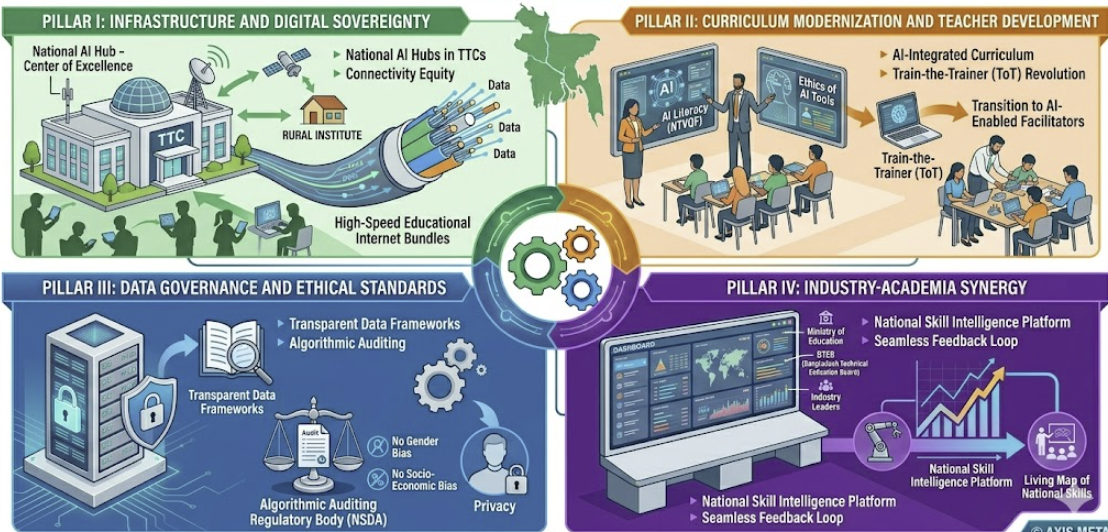
Pillar I: Infrastructure and Digital Sovereignty
Bangladesh must bridge the urban-rural digital divide to ensure equitable AI access. Policies should prioritize:
-
National AI Hubs: Establishing dedicated AI-enabled “Centers of Excellence” within existing Technical Training Centers (TTCs) that serve as regional resource centers for rural institutes.
-
Connectivity Equity: Implementing subsidized, high-speed educational internet bundles for registered VET learners and institutions to ensure that digital training materials are accessible nationwide.
Pillar II: Curriculum Modernization and Teacher Development
Technology is only as effective as the hands that wield it.
-
AI-Integrated Curriculum: AI literacy must be embedded across all NTVQF levels, teaching not just how to use AI, but how to understand the ethical implications of the tools being used.
-
Train-the-Trainer (ToT) Revolution: A massive, nationwide upskilling campaign is needed to transition instructors from traditional lecturers to AI-enabled facilitators. This requires specialized training in digital pedagogy and the use of AI-based assessment platforms.
Pillar III: Data Governance and Ethical Standards
As AI relies on data, its misuse can lead to algorithmic bias and privacy infringements.
-
Transparent Data Frameworks: Developing clear guidelines on how student data—such as performance analytics and behavioral patterns—is collected, stored, and used.
-
Algorithmic Auditing: Establishing a regulatory body, potentially under the NSDA or a central AI office, to periodically audit AI platforms used in education to ensure they do not exhibit gender or socio-economic bias.
Pillar IV: Industry-Academia Synergy
AI enables a seamless feedback loop between the factory and the classroom.
-
National Skill Intelligence Platform: Creating a centralized, AI-driven dashboard that connects the Ministry of Education, BTEB, and industry leaders, providing a living map of the national skills landscape.
Addressing Implementation Challenges
Policymakers must remain cognizant of the constraints inherent in the Bangladeshi context:
-
The Skill Gap: There is an acute shortage of domestic AI talent capable of building localized tools. Policies should incentivize domestic startups to focus on vernacular AI (Bangla-language support) for TVET.
-
Resource Constraints: High-performance computing is expensive. A pragmatic approach involves “Light AI”—prioritizing cloud-based, mobile-friendly AI solutions that do not require specialized hardware in every classroom.
-
Social Resistance: There is a lingering stigma regarding vocational education. AI-driven TVET should be marketed as a high-tech, modern pathway that provides a competitive edge in the global digital economy.
A Phased Implementation Roadmap
For sustainable growth, I recommend a phased approach:
-
Phase 1 (Short-term): Focus on AI-assisted tools for trainers (e.g., automated lesson planning tools like TeacherMatic, assessment grading support) to immediately reduce workload and familiarize staff with AI.
-
Phase 2 (Medium-term): Pilot adaptive learning platforms in high-demand trades like ICT and Renewable Energy, using the insights gained to scale these systems to other sectors.
-
Phase 3 (Long-term): Integrate AI into national-level assessment and certification frameworks, establishing a fully digitized, real-time responsive skill development ecosystem.
Conclusion
The integration of AI into TVET is the most significant opportunity for Bangladesh to leapfrog traditional development bottlenecks. By creating a policy environment that emphasizes human-centric AI, ensures inclusivity, and promotes responsible innovation, Bangladesh can transform its TVET sector into a world-class engine of economic growth. As a TVET expert, I urge our policymakers to act with boldness, ensuring that no student is left behind in the transition to the digital future.
About the Author
Khan Mohammad Mahmud Hasan is a distinguished TVET Expert, curriculum specialist. With over 20 years of experience in leading systemic reforms across the national skills ecosystem, he specializes in bridging the gap between educational theory and industrial reality. His work, which spans international agency-funded projects like those of the ILO, GIZ, and the World Bank, is dedicated to modernizing TVET through technology, behavioral psychology, and evidence-based career counseling. He is a passionate advocate for digital upskilling and the ethical integration of emerging technologies to empower the Bangladeshi workforce. Visit his website for details.